Hadley Falls Company Housing District

The National Park Service has not published a boundary polygon for this district; the map shows the listed properties inside it and the district's reference point.
Why it's listed
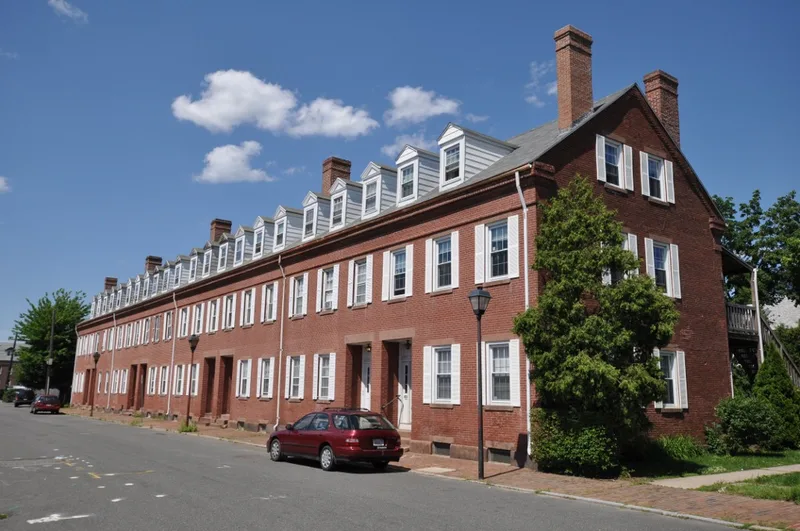
Five rows of two-and-a-half story brick workers' housing line Center, North Canal, Grover and Lyman Streets in Holyoke, Massachusetts. Each row holds eight to ten units and has pedimented dormers (except the Lyman Street row), paired recessed entrances, shared chimneys, a plain brick frieze with a narrow cornice, and sandstone lintels. Construction began in 1848 for the Hadley Falls Company, to designs by mill engineer John Chase and built by contractor Charles McClallan. The company, incorporated in 1847, set out to follow the Lowell model by damming the Connecticut River, building canals, operating industries and housing its workers. These rows were the largest domestic grouping of their type and period in Massachusetts and the earliest company housing in Holyoke. Some windows, entrances and chimneys have been altered, and later dormers were added to some rows. Condition is uneven, with some rows sound and others needing restoration.
Machine-generated summary. This summary was generated by a language model from the official nomination document and has not been reviewed line by line by an editor. It may contain errors. Check the source document before relying on any detail. Source: nomination document (PDF) · catalog entry. Generated October 2026 (model claude-sonnet-5-5, prompt v1.0-2026-10-29).
| Period of significance | 1847-1850s |
|---|---|
| Areas of significance | Industry, Architecture |
| Acreage | 2.1 |
| Boundary source | not published |
| Full listing page | Hadley Falls Company Housing District (property record) |
What listing means for this property
This is a historic district. Buildings within its boundary are either contributing (they add to the district's significance) or non-contributing. Owners of contributing income-producing buildings can claim the 20% federal rehabilitation tax credit; homeowners should look at state credits. National Register districts impose no design review by themselves; a local historic district ordinance, if one exists, does (the difference explained).
General information, not legal or tax advice. Rules change; confirm with your State Historic Preservation Office or a qualified adviser.