Front Street Block

The National Park Service has not published a boundary polygon for this district; the map shows the listed properties inside it and the district's reference point.
Why it's listed
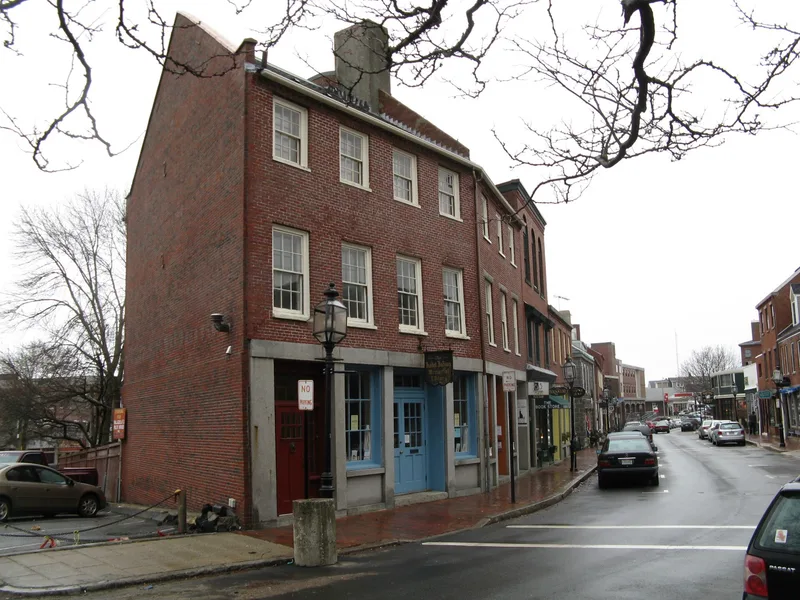
Four connected brick buildings at 55-71 Main Street, once called Front Street, form a commercial block in Gloucester's West End. They were put up around 1831 to 1833, after the Great Fire of September 1830 destroyed the stores and businesses between Front Street and the harbor. Rather than rebuild in cheaper wood, owners chose brick framed with granite, and they shared common party walls while keeping separate fronts, roofs, cornices, lintels and gutters. Two buildings rise three stories and two were originally two stories; one of these was raised to three stories and given a Victorian facade about 1890. The Federalist design is simple and coordinated, with a dentil-like brick cornice and six-light sashes. The block is regarded as significant for its architecture and for showing how Gloucester recovered and grew after the fire. It sits near the harbor and the 1768 Sargent-Murray-Gilman-Hough House, reinforcing the town's New England seaport character.
Machine-generated summary. This summary was generated by a language model from the official nomination document and has not been reviewed line by line by an editor. It may contain errors. Check the source document before relying on any detail. Source: nomination document (PDF) · catalog entry. Generated October 2026 (model claude-sonnet-5-5, prompt v1.0-2026-10-29).
| Period of significance | 19th Century (c. 1831) |
|---|---|
| Styles | Federalist, with one Victorian facade added about 1890 |
| Areas of significance | Community Planning and Development, Commerce, Architecture |
| Acreage | 0.3 |
| Boundary source | not published |
| Full listing page | Front Street Block (property record) |
What listing means for this property
This is a historic district. Buildings within its boundary are either contributing (they add to the district's significance) or non-contributing. Owners of contributing income-producing buildings can claim the 20% federal rehabilitation tax credit; homeowners should look at state credits. National Register districts impose no design review by themselves; a local historic district ordinance, if one exists, does (the difference explained).
General information, not legal or tax advice. Rules change; confirm with your State Historic Preservation Office or a qualified adviser.