Fisher School-High Street Historic District

The National Park Service has not published a boundary polygon for this district; the map shows the listed properties inside it and the district's reference point.
Why it's listed
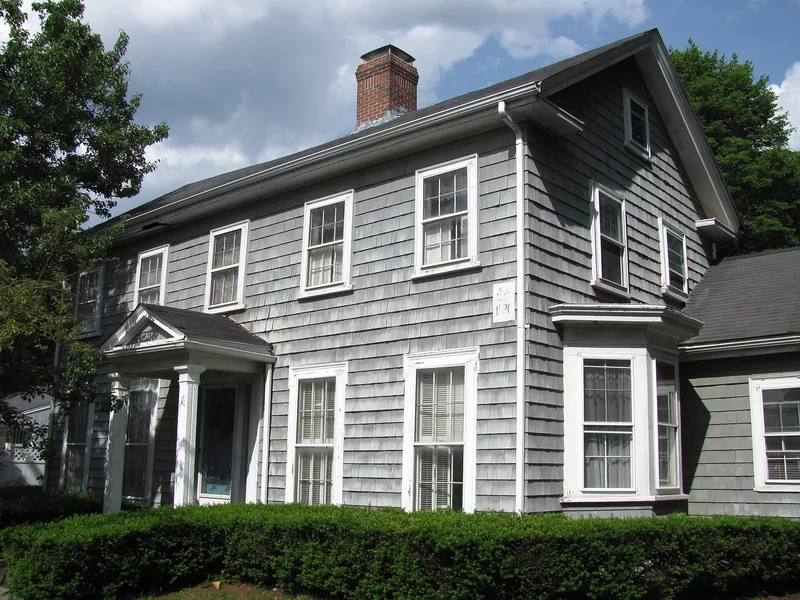
Along High Street in Westwood, Massachusetts, a small group of twenty contributing resources preserves the character of the former West Dedham village. Most are two-and-one-half-story, center-entrance houses from the first half of the nineteenth century, blending Federal and Greek Revival forms with later Italianate touches such as bracketed doorhoods and projecting bays. Several keep their attached barns. Institutional buildings include the First Baptist Church, whose timbers date to a 1731 meetinghouse reassembled in 1809 and moved again in 1989, and the 1845 one-room Fisher School, relocated to protect the town's last rural schoolhouse. The 1939 high school, now a middle school, adds a later chapter. The West Dedham Cemetery, in use since 1752, is enclosed by a wrought iron fence made in 1843 by Benjamin Tubbs at his foundry within the district. Together these resources illustrate architectural change and the community's development from 1752 to 1950.
Machine-generated summary. This summary was generated by a language model from the official nomination document and has not been reviewed line by line by an editor. It may contain errors. Check the source document before relying on any detail. Source: nomination document (PDF) · catalog entry. Generated October 2026 (model claude-sonnet-5-5, prompt v1.0-2026-10-29).
| Period of significance | 1752-1950 |
|---|---|
| Styles | Federal, Greek Revival, Italianate, Colonial Revival |
| Areas of significance | Architecture, Community Planning and Development |
| Acreage | 40 |
| Boundary source | not published |
| Full listing page | Fisher School-High Street Historic District (property record) |
What listing means for this property
This is a historic district. Buildings within its boundary are either contributing (they add to the district's significance) or non-contributing. Owners of contributing income-producing buildings can claim the 20% federal rehabilitation tax credit; homeowners should look at state credits. National Register districts impose no design review by themselves; a local historic district ordinance, if one exists, does (the difference explained).
General information, not legal or tax advice. Rules change; confirm with your State Historic Preservation Office or a qualified adviser.