Farlow Hill Historic District

Why it's listed
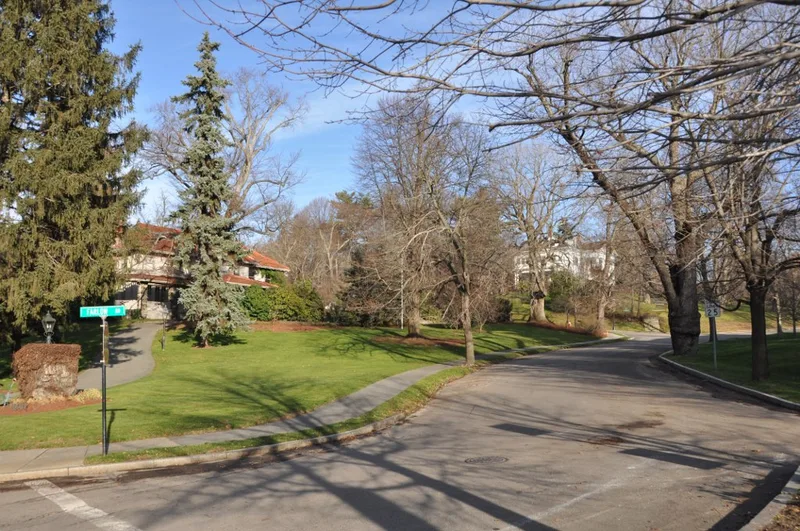
Farlow Hill is a residential district of 37 houses and one vacant lot in the easternmost part of Newton Corner, close to the Boston/Brighton line. It occupies the former forty-acre estate of businessman and philanthropist John Farlow, which was subdivided by a syndicate after his death in the mid-1890s. Plans were drawn by the engineering firm of Aspinwall and Lincoln, and the curving streets follow the contours of the hill, giving many houses wide views. Most homes were built between the 1880s and the 1930s, many designed by architects such as Kilham & Hopkins, Chapman & Frazer, Brainerd & Leeds and John Barnard. Craftsman, Colonial Revival and Tudor Revival styles predominate, built of fine materials on large landscaped lots. Restrictions on cost, use and location of houses were part of the original development. The district was listed for its reflection of Newton's upscale early twentieth century suburban growth and its architectural quality, and it remains in excellent condition as a residential neighborhood.
Machine-generated summary. This summary was generated by a language model from the official nomination document and has not been reviewed line by line by an editor. It may contain errors. Check the source document before relying on any detail. Source: nomination document (PDF) · catalog entry. Generated October 2026 (model claude-sonnet-5-5, prompt v1.0-2026-10-29).
| Period of significance | 1880s-1930s |
|---|---|
| Styles | Craftsman, Colonial Revival and Tudor Revival |
| Areas of significance | Community Planning and Development, Architecture |
| Acreage | 21.3 |
| Boundary source | NPS cultural-resource GIS polygon |
| Full listing page | Farlow Hill Historic District (property record) |
What listing means for this property
This is a historic district. Buildings within its boundary are either contributing (they add to the district's significance) or non-contributing. Owners of contributing income-producing buildings can claim the 20% federal rehabilitation tax credit; homeowners should look at state credits. National Register districts impose no design review by themselves; a local historic district ordinance, if one exists, does (the difference explained).
General information, not legal or tax advice. Rules change; confirm with your State Historic Preservation Office or a qualified adviser.