Eastern Point Light Station

The National Park Service has not published a boundary polygon for this district; the map shows the listed properties inside it and the district's reference point.
Why it's listed
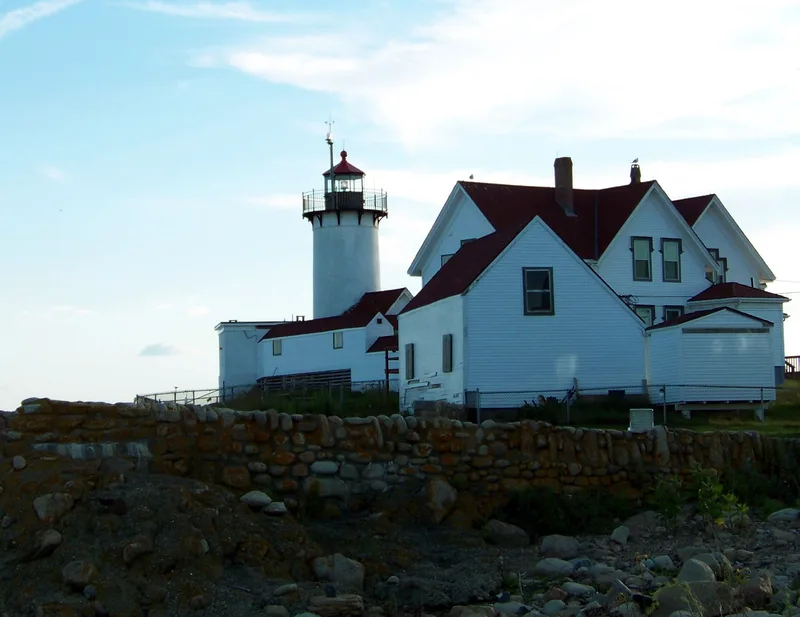
Eastern Point Light Station occupies a rocky promontory overlooking Dog Bar Reef at the eastern entrance to Gloucester Harbor. The one-acre site holds a complete set of buildings: a 38-foot cylindrical brick tower rebuilt in 1890 on its 1832 masonry foundation, a Gothic Revival double keeper's dwelling from 1879, a Shingle Style assistant keeper's house from 1908, an oil house, a long covered walkway ending in a brick building painted as a red and white daymark, and later fog signal and radio beacon equipment. The grounds are described as well integrated and massed. The station was listed as the largest intact light station in Massachusetts, retaining its period tower, dwelling, walkway, oil house and bell tower. It also has a link to the painter Winslow Homer, who lived in the lighthouse in 1880, during the years his scenes of the local maritime community became among his best known. Automated in 1986, it remains active.
Machine-generated summary. This summary was generated by a language model from the official nomination document and has not been reviewed line by line by an editor. It may contain errors. Check the source document before relying on any detail. Source: nomination document (PDF) · catalog entry. Generated October 2026 (model claude-sonnet-5-5, prompt v1.0-2026-10-29).
| Styles | Gothic Revival/Queen Anne double keeper's dwelling (1879); Shingle Style secondary keeper's dwelling (1908) |
|---|---|
| Areas of significance | Engineering, Transportation, Architecture, Maritime History |
| Acreage | 1 |
| Boundary source | not published |
| Full listing page | Eastern Point Light Station (property record) |
What listing means for this property
This is a historic district. Buildings within its boundary are either contributing (they add to the district's significance) or non-contributing. Owners of contributing income-producing buildings can claim the 20% federal rehabilitation tax credit; homeowners should look at state credits. National Register districts impose no design review by themselves; a local historic district ordinance, if one exists, does (the difference explained).
General information, not legal or tax advice. Rules change; confirm with your State Historic Preservation Office or a qualified adviser.