Douglass, Frederick, Square Historic District

Why it's listed
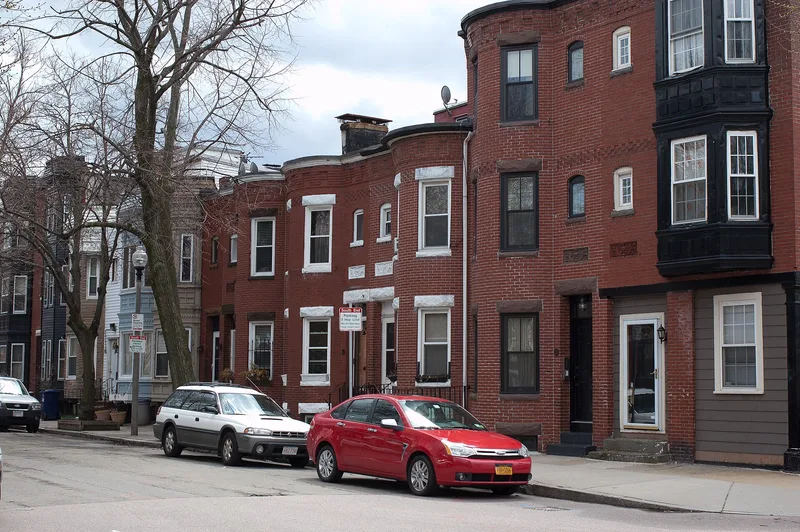
Lower Roxbury's Frederick Douglass Square Historic District is a compact five-acre pocket of brick row houses and apartment blocks, built on tidal marsh that the Tremont Improvement Company drained and filled in the late 1860s. Less than one-sixth of the original subdivision survives, since urban renewal demolition in the late 1960s cleared most of the neighborhood. The remaining 116 buildings are mostly two- and three-story Panel Brick and Queen Anne row houses. Seventy-seven were financed between 1886 and 1890 by Robert Treat Paine, Jr., a social reformer who believed housing for working families should be sanitary and also attractive. Architect George W. Pope gave the small side-passage houses bow fronts, pressed metal oriels, terra-cotta plaques and corbelled cornices. The district takes its name from the nearby square honoring Frederick Douglass, which became a gathering place for political rallies and Civil Rights protests in a largely African-American community. It is recognized for its architecture, community planning and social history.
Machine-generated summary. This summary was generated by a language model from the official nomination document and has not been reviewed line by line by an editor. It may contain errors. Check the source document before relying on any detail. Source: nomination document (PDF) · catalog entry. Generated October 2026 (model claude-sonnet-5-5, prompt v1.0-2026-10-29).
| Period of significance | C. 1866-1946 |
|---|---|
| Styles | Late Victorian: Second Empire; Queen Anne; High Victorian Gothic; Late 19th Century Revival: Federal Revival |
| Areas of significance | Architecture, Community Planning and Development, Social History |
| Acreage | 5 |
| Boundary source | NPS cultural-resource GIS polygon |
| Full listing page | Douglass, Frederick, Square Historic District (property record) |
What listing means for this property
This is a historic district. Buildings within its boundary are either contributing (they add to the district's significance) or non-contributing. Owners of contributing income-producing buildings can claim the 20% federal rehabilitation tax credit; homeowners should look at state credits. National Register districts impose no design review by themselves; a local historic district ordinance, if one exists, does (the difference explained).
General information, not legal or tax advice. Rules change; confirm with your State Historic Preservation Office or a qualified adviser.