Day Estate Historic District

Why it's listed
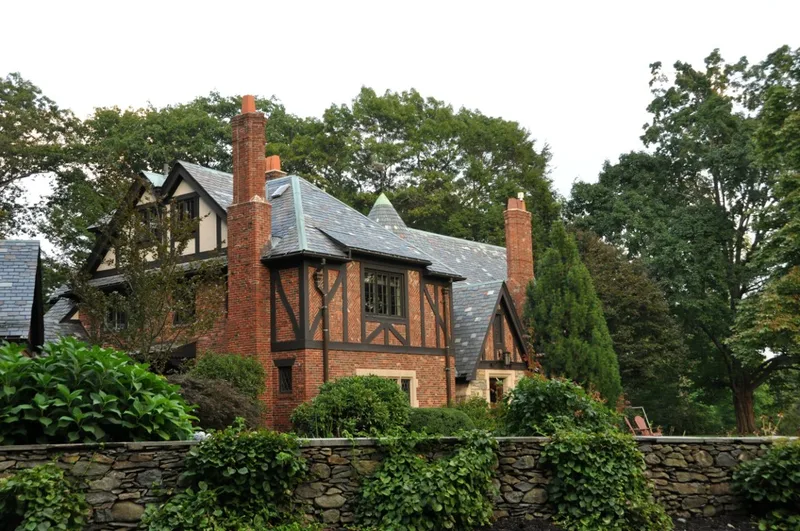
Six large brick houses on the southern and western edges of a block in West Newton make up this small district, built in 1929 and 1930 on land once part of banker Henry B. Day's estate. Day assembled the block shortly after Commonwealth Avenue opened. As the 1920s building boom peaked, the estate was subdivided, and the lots were developed by Noble & Nutting and the Cragie Realty Trust. Most of the houses were designed by William J. Freethey, with one by Newton architect Hawley W. Morton. Five are Tudor Revival, with slate roofs, limestone trim, half-timbering in places, and casement windows. The house at 1395 Commonwealth Avenue shows French-derived features. The group illustrates how large estates were broken up for expansive residential development and how Commonwealth Avenue changed formerly remote parts of central Newton. The Day house itself and three modern houses lie outside the boundary. The houses remain in residential use and are in good condition.
Machine-generated summary. This summary was generated by a language model from the official nomination document and has not been reviewed line by line by an editor. It may contain errors. Check the source document before relying on any detail. Source: nomination document (PDF) · catalog entry. Generated October 2026 (model claude-sonnet-5-5, prompt v1.0-2026-10-29).
| Period of significance | 1929-1930 |
|---|---|
| Styles | Tudor Revival (with French-derived elements) |
| Areas of significance | Community Planning and Development, Architecture |
| Acreage | 4.3 |
| Boundary source | NPS cultural-resource GIS polygon |
| Full listing page | Day Estate Historic District (property record) |
What listing means for this property
This is a historic district. Buildings within its boundary are either contributing (they add to the district's significance) or non-contributing. Owners of contributing income-producing buildings can claim the 20% federal rehabilitation tax credit; homeowners should look at state credits. National Register districts impose no design review by themselves; a local historic district ordinance, if one exists, does (the difference explained).
General information, not legal or tax advice. Rules change; confirm with your State Historic Preservation Office or a qualified adviser.