Custom House District

Why it's listed
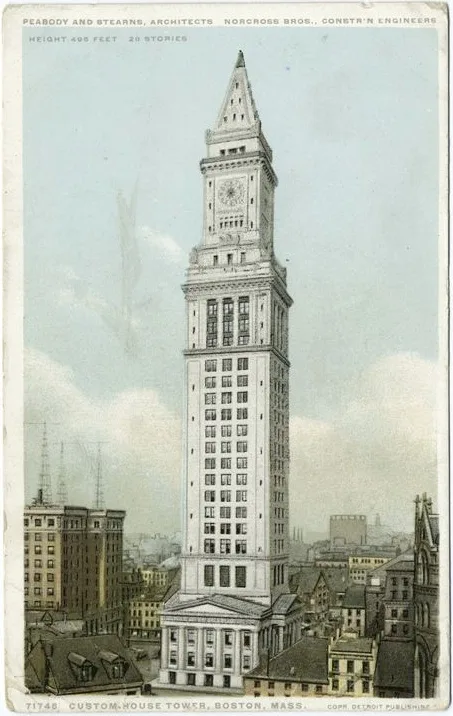
This 15.9-acre district in downtown Boston grew from the city's old waterfront, where State Street, Long Wharf, Broad Street and Milk Street met the harbor. In 1805 the Broad Street Association, led by Uriah Cotting with Charles Bulfinch as planner, filled land south of Long Wharf and laid out wide streets lined with uniform brick buildings. The oldest surviving buildings, from about 1810, are four-story Federal-style structures on Broad and Milk Streets, along with the remaining units of Central Wharf of 1819. Later additions include the Greek Revival Custom House by Ammi B. Young, built 1834-47 and topped by a tower in 1913-15, the Romanesque Revival Grain and Flour Exchange, massive granite warehouses, mansard-roofed Victorian buildings, and a cast-iron storefront. The district was listed because it shows how planned development allowed a varied but cohesive group of commercial buildings to evolve alongside Boston's mercantile growth.
Machine-generated summary. This summary was generated by a language model from the official nomination document and has not been reviewed line by line by an editor. It may contain errors. Check the source document before relying on any detail. Source: nomination document (PDF) · catalog entry. Generated October 2026 (model claude-sonnet-5-5, prompt v1.0-2026-10-29).
| Styles | Mixed commercial architecture: Federal, Greek Revival, Romanesque Revival, Victorian and granite warehouse styles |
|---|---|
| Areas of significance | Commerce, Historic - Non-Aboriginal, Architecture, Community Planning and Development |
| Acreage | 15.9 |
| Boundary source | NPS cultural-resource GIS polygon |
| Full listing page | Custom House District (property record) |
What listing means for this property
This is a historic district. Buildings within its boundary are either contributing (they add to the district's significance) or non-contributing. Owners of contributing income-producing buildings can claim the 20% federal rehabilitation tax credit; homeowners should look at state credits. National Register districts impose no design review by themselves; a local historic district ordinance, if one exists, does (the difference explained).
General information, not legal or tax advice. Rules change; confirm with your State Historic Preservation Office or a qualified adviser.