Commonwealth Avenue Historic District

Why it's listed
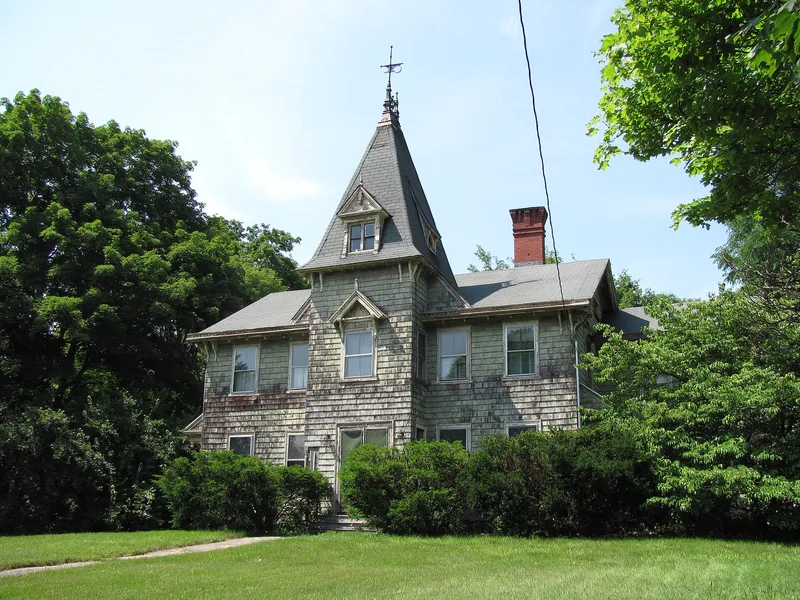
Commonwealth Avenue in North Attleborough carries a three-eighths-mile stretch of large houses and two jewelry factories near the Ten Mile River. The district grew out of the industrial activity at The Falls, where manufacturers and workers built homes close to the mills. V.H. Blackinton began making jewelry at 140 Commonwealth Avenue in 1857, and the Freeman factory on Robinson Street produced jewelry for more than a century. The houses range from early 19th-century Federal and Greek Revival examples, including the Robinson House at 161 and a center-chimney house at 172 dating to about 1800, to a Modern Gothic house of 1881-82, Queen Anne houses of the 1880s and 1890s, and a Dutch Colonial house of about 1924. Two of them echo designs from Providence, Rhode Island, reflecting business and cultural ties. Together the buildings show how industrial success shaped local housing and how factories and residences sat side by side.
Machine-generated summary. This summary was generated by a language model from the official nomination document and has not been reviewed line by line by an editor. It may contain errors. Check the source document before relying on any detail. Source: nomination document (PDF) · catalog entry. Generated October 2026 (model claude-sonnet-5-5, prompt v1.0-2026-10-29).
| Period of significance | Ca. 1800-1953 |
|---|---|
| Styles | Federal, Greek Revival, Queen Anne (also Modern Gothic and Dutch Colonial houses described) |
| Areas of significance | Architecture, Community Planning and Development, Industry, Social History |
| Acreage | 12.5 |
| Boundary source | NPS cultural-resource GIS polygon |
| Full listing page | Commonwealth Avenue Historic District (property record) |
What listing means for this property
This is a historic district. Buildings within its boundary are either contributing (they add to the district's significance) or non-contributing. Owners of contributing income-producing buildings can claim the 20% federal rehabilitation tax credit; homeowners should look at state credits. National Register districts impose no design review by themselves; a local historic district ordinance, if one exists, does (the difference explained).
General information, not legal or tax advice. Rules change; confirm with your State Historic Preservation Office or a qualified adviser.