City Hall Historic District

The National Park Service has not published a boundary polygon for this district; the map shows the listed properties inside it and the district's reference point.
Why it's listed
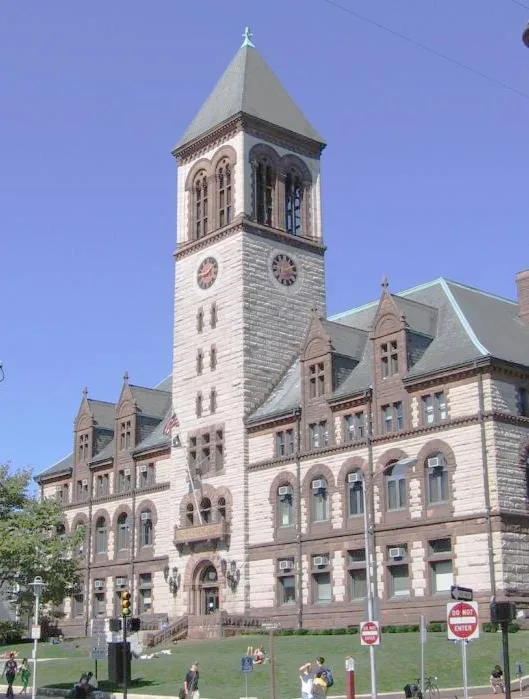
Five buildings along Massachusetts Avenue and nearby side streets in Cambridge's Central Square make up this 3.042-acre district, which records the area's change in the late 1800s from single-family homes and shops into a civic center. Cambridge City Hall (1889), designed by Longfellow, Alden & Harlow in the Richardsonian Romanesque style, sits on a rise above the avenue and is still used as city offices. Across Inman Street, John A. Hasty's 1888 Mutual Fire Insurance Building, with its checkerboard masonry bands and corner tower, pairs with it. Also included are the Cambridge Electric Light Company Building of 1912 by Shepley, Rutan & Coolidge, the 1910 YWCA building by Newhall & Blevins with its open roof loggia, and an 1822 church moved to Inman Street in 1888 and remodelled in 1858 by Thomas Silloway. Together they show how civic and corporate buildings gathered at this location.
Machine-generated summary. This summary was generated by a language model from the official nomination document and has not been reviewed line by line by an editor. It may contain errors. Check the source document before relying on any detail. Source: nomination document (PDF) · catalog entry. Generated October 2026 (model claude-sonnet-5-5, prompt v1.0-2026-10-29).
| Period of significance | 1880-1912 |
|---|---|
| Styles | Mixed styles: Richardsonian Romanesque, Renaissance Revival, Italian Palazzo, Italianate |
| Areas of significance | Architecture |
| Acreage | 3 |
| Boundary source | not published |
| Full listing page | City Hall Historic District (property record) |
What listing means for this property
This is a historic district. Buildings within its boundary are either contributing (they add to the district's significance) or non-contributing. Owners of contributing income-producing buildings can claim the 20% federal rehabilitation tax credit; homeowners should look at state credits. National Register districts impose no design review by themselves; a local historic district ordinance, if one exists, does (the difference explained).
General information, not legal or tax advice. Rules change; confirm with your State Historic Preservation Office or a qualified adviser.