Church Green Buildings Historic District

The National Park Service has not published a boundary polygon for this district; the map shows the listed properties inside it and the district's reference point.
Why it's listed
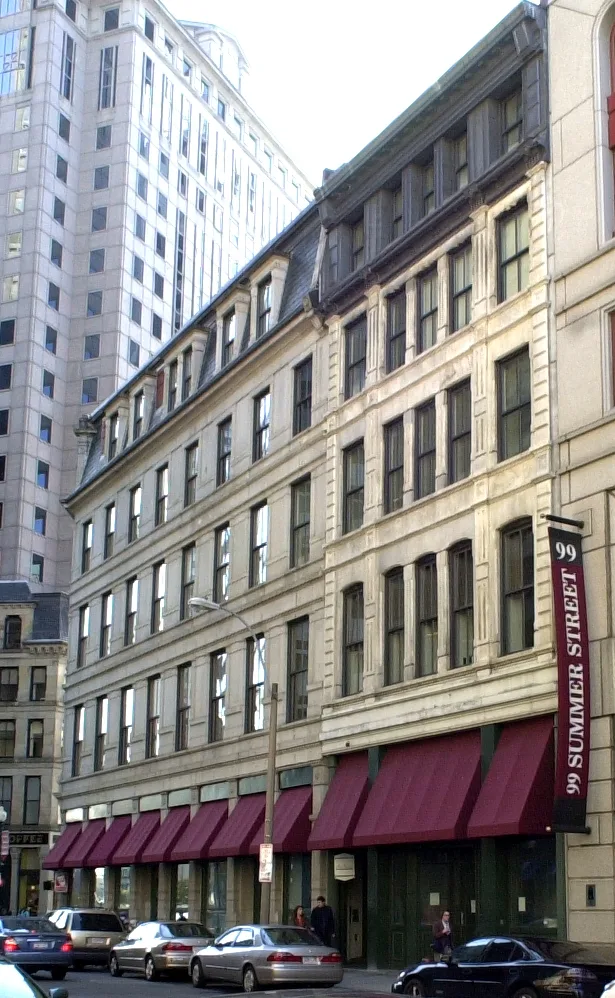
Two adjoining commercial buildings at 101-113 Summer Street in downtown Boston form this district. The larger, 105-113 Summer Street, was built in 1873 at the point where Summer, Bedford and Lincoln Streets meet. It is a 4½-story granite structure with a slate mansard roof, canted corner bays and carved Neo-Grec detail. Next door, 101-103 Summer Street is a five-story marble building that combines Italianate and Neo-Grec elements. Both went up after the Great Boston Fire of 1872 destroyed hundreds of downtown buildings, and they reflect the quick rebuilding of the area. The larger building housed the Shoe and Leather Exchange, run by a trade association central to one of Boston's leading industries, and later hosted shoe dealers, tailors, banks and shops. Its designer, John Lyman Faxon, was a young architect trained at M.I.T. Storefronts and interiors were rebuilt in 1981 and 1998, but the upper facades remain largely as built.
Machine-generated summary. This summary was generated by a language model from the official nomination document and has not been reviewed line by line by an editor. It may contain errors. Check the source document before relying on any detail. Source: nomination document (PDF) · catalog entry. Generated October 2026 (model claude-sonnet-5-5, prompt v1.0-2026-10-29).
| Period of significance | 1873-1949 |
|---|---|
| Styles | Second Empire: Neo-Grec; Italianate: Neo-Grec |
| Areas of significance | Architecture, Commerce |
| Acreage | 0.9 |
| Boundary source | not published |
| Full listing page | Church Green Buildings Historic District (property record) |
What listing means for this property
This is a historic district. Buildings within its boundary are either contributing (they add to the district's significance) or non-contributing. Owners of contributing income-producing buildings can claim the 20% federal rehabilitation tax credit; homeowners should look at state credits. National Register districts impose no design review by themselves; a local historic district ordinance, if one exists, does (the difference explained).
General information, not legal or tax advice. Rules change; confirm with your State Historic Preservation Office or a qualified adviser.