Chestnut Hill Reservoir Historic District

Why it's listed
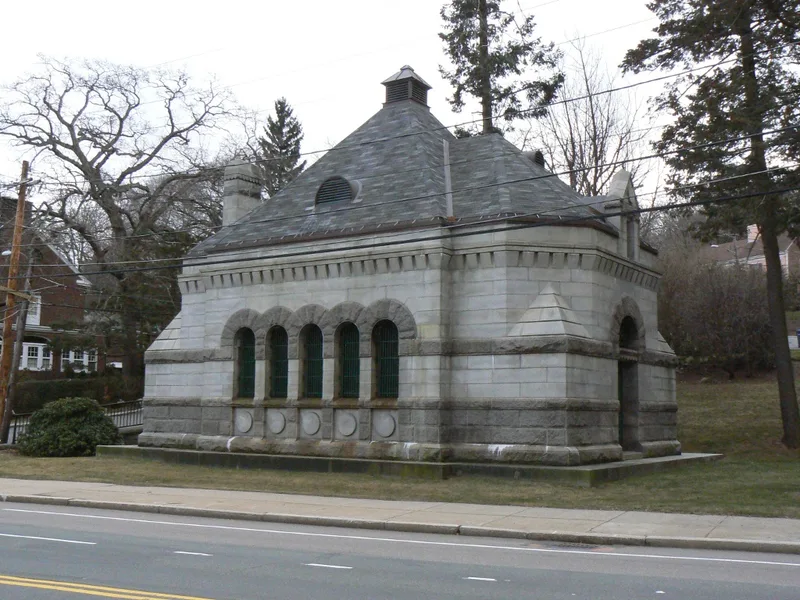
Chestnut Hill Reservoir and its surrounding buildings form a municipal waterworks complex in Brighton, Boston, with one outlying structure in Newton. The reservoir was built from 1865 to 1870 to supplement the supply from the Cochituate Aqueduct and later received water from the Sudbury Aqueduct. Around it stand three gatehouses, a connection chamber, the Sudbury Terminal Chamber and two pumping stations. The High Service Pumping Station, designed by city architect Arthur Vinal in Richardsonian Romanesque style, opened in 1887-88 and housed a Leavitt triple expansion engine. The Low Service Station, by Shepley, Rutan and Coolidge, is a restrained Beaux Arts building of white limestone. The gatehouses are granite and classical in character. The complex was the main distribution point for the metropolitan Boston system for about a century, until a city tunnel opened in the 1950s and the pumping stations were phased out. It is valued for its history in water supply and for its varied but cohesive architecture.
Machine-generated summary. This summary was generated by a language model from the official nomination document and has not been reviewed line by line by an editor. It may contain errors. Check the source document before relying on any detail. Source: nomination document (PDF) · catalog entry. Generated October 2026 (model claude-sonnet-5-5, prompt v1.0-2026-10-29).
| Period of significance | 1868-1926 |
|---|---|
| Styles | Richardsonian Romanesque, Beaux Arts, Classical Revival |
| Areas of significance | Community Planning and Development, Engineering, Politics/Government, Architecture |
| Acreage | 95 |
| Boundary source | NPS cultural-resource GIS polygon |
| Full listing page | Chestnut Hill Reservoir Historic District (property record) |
What listing means for this property
This is a historic district. Buildings within its boundary are either contributing (they add to the district's significance) or non-contributing. Owners of contributing income-producing buildings can claim the 20% federal rehabilitation tax credit; homeowners should look at state credits. National Register districts impose no design review by themselves; a local historic district ordinance, if one exists, does (the difference explained).
General information, not legal or tax advice. Rules change; confirm with your State Historic Preservation Office or a qualified adviser.