Cathedral of St. George Historic District

The National Park Service has not published a boundary polygon for this district; the map shows the listed properties inside it and the district's reference point.
Why it's listed
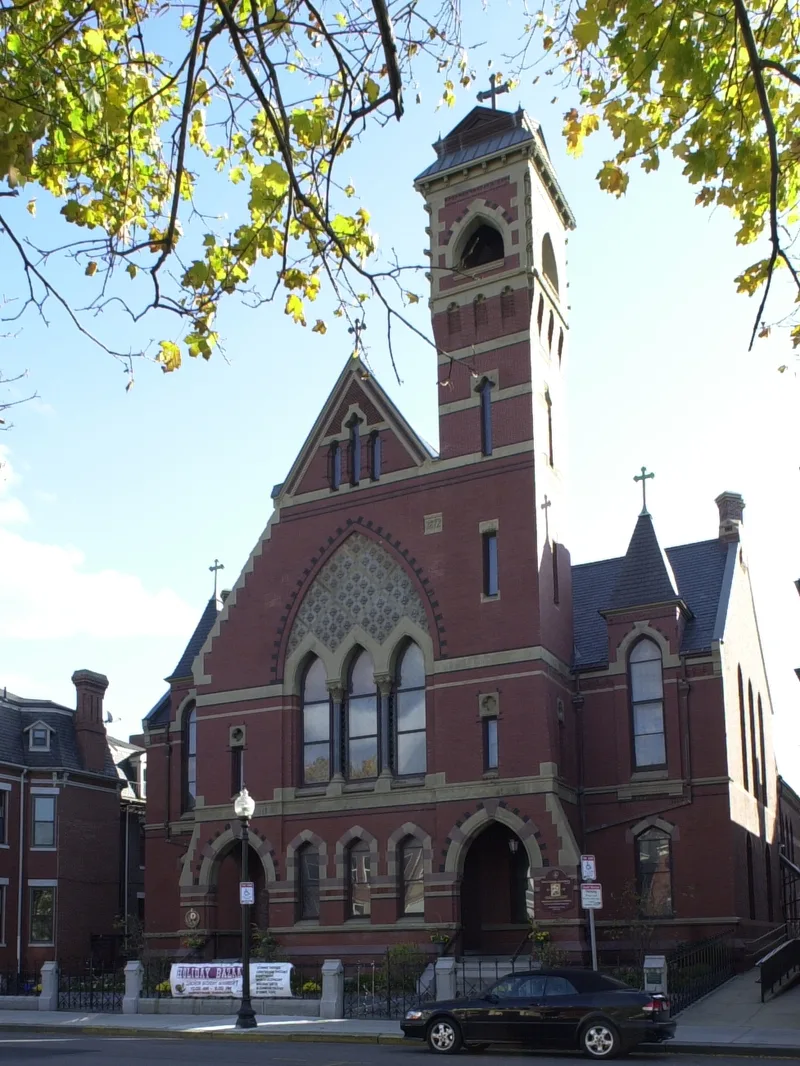
Three brick buildings on East Broadway in South Boston form this small district: a church flanked by two houses, set on one of the highest points of the neighborhood. The church was built for a Unitarian congregation between 1872 and 1873 and designed by local architect Samuel J.F. Thayer in a High Victorian Gothic style influenced by Venetian Gothic. Its T-shaped plan, lancet arches, sandstone trim and engaged tower solved the problem of a narrow lot hemmed in by neighboring buildings. Inside, the black walnut woodwork, balcony, parlors and Sunday School room survive largely intact, along with a Byzantine-style altar screen added when the building became the Cathedral of St. George. The two houses, at 517 and 525 East Broadway, were linked to prominent church members and builders, and a deed condition required that only brick or stone dwellings be built beside the church. Together they show how a church and its surrounding residences developed in South Boston during the 1870s.
Machine-generated summary. This summary was generated by a language model from the official nomination document and has not been reviewed line by line by an editor. It may contain errors. Check the source document before relying on any detail. Source: nomination document (PDF) · catalog entry. Generated October 2026 (model claude-sonnet-5-5, prompt v1.0-2026-10-29).
| Period of significance | 1868-1949 |
|---|---|
| Styles | Late Victorian/High Victorian Gothic |
| Areas of significance | Architecture, Social History, Community Planning and Development, European |
| Acreage | 0.9 |
| Boundary source | not published |
| Full listing page | Cathedral of St. George Historic District (property record) |
What listing means for this property
This is a historic district. Buildings within its boundary are either contributing (they add to the district's significance) or non-contributing. Owners of contributing income-producing buildings can claim the 20% federal rehabilitation tax credit; homeowners should look at state credits. National Register districts impose no design review by themselves; a local historic district ordinance, if one exists, does (the difference explained).
General information, not legal or tax advice. Rules change; confirm with your State Historic Preservation Office or a qualified adviser.