American Woolen Company Townhouses

The National Park Service has not published a boundary polygon for this district; the map shows the listed properties inside it and the district's reference point.
Why it's listed
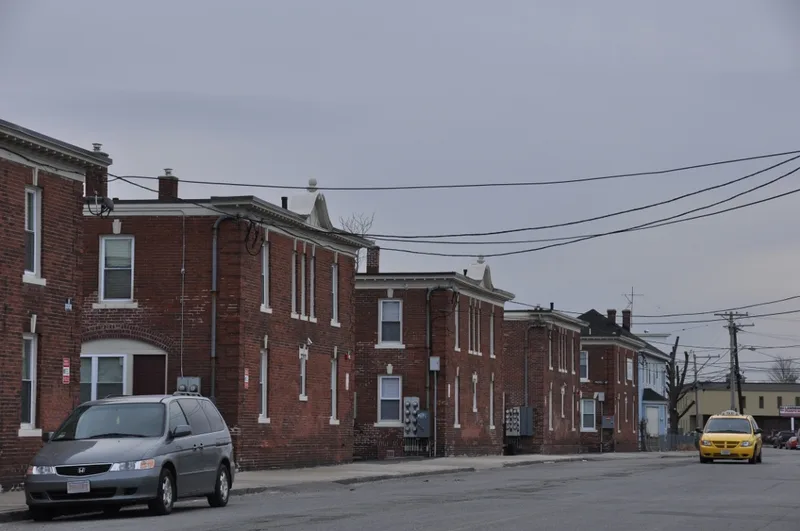
Six two-story red brick buildings on Market Street in South Lawrence, Massachusetts, hold seven residential units each. The American Woolen Company built them around 1907, after buying the lot from the Essex Company, as part of its only major housing project, which provided homes for 142 families between 1906 and 1910. Local architect James E. Allen designed the Georgian Revival buildings, which have flat roofs, brick quoins, bracketed eaves, scrolled or segmental pediments and small oriel windows. Three private ways, named for company mills, run between the buildings. A 1912 survey of Lawrence housing judged the company's houses superior to most mill-built and commercially built housing in the city, and singled out the brick townhouses as interesting homes for working people. Mill operatives from the company's Lawrence mills lived in them. The buildings retain largely intact layouts and historic trim, though doors and windows were replaced in a 2010 rehabilitation. The group is listed for its association with company housing and for its architecture.
Machine-generated summary. This summary was generated by a language model from the official nomination document and has not been reviewed line by line by an editor. It may contain errors. Check the source document before relying on any detail. Source: nomination document (PDF) · catalog entry. Generated October 2026 (model claude-sonnet-5-5, prompt v1.0-2026-10-29).
| Period of significance | 1907-1962 |
|---|---|
| Styles | Colonial Revival/Georgian Revival |
| Areas of significance | Architecture, Community Planning and Development |
| Acreage | 0.9 |
| Boundary source | not published |
| Full listing page | American Woolen Company Townhouses (property record) |
What listing means for this property
This is a historic district. Buildings within its boundary are either contributing (they add to the district's significance) or non-contributing. Owners of contributing income-producing buildings can claim the 20% federal rehabilitation tax credit; homeowners should look at state credits. National Register districts impose no design review by themselves; a local historic district ordinance, if one exists, does (the difference explained).
General information, not legal or tax advice. Rules change; confirm with your State Historic Preservation Office or a qualified adviser.