1767 Milestones

The National Park Service has not published a boundary polygon for this district; the map shows the listed properties inside it and the district's reference point.
Why it's listed
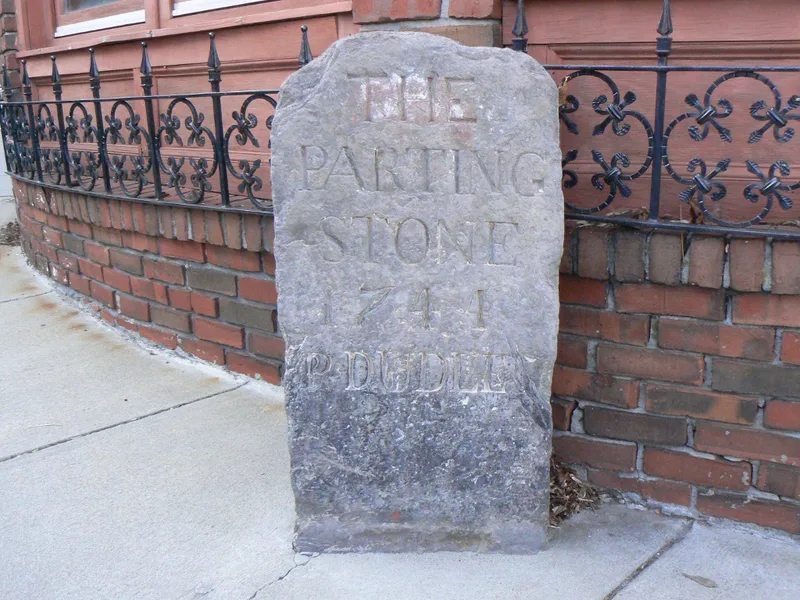
Forty milestones set in 1767 survive along the Old Post Road between Boston and Springfield, out of an original ninety-nine. They mark mile intervals and are round-headed or rectangular monoliths, granite in the east and gray or brown sandstone in Worcester and Hampden Counties. Most carry a short inscription giving the number of miles from Boston. The best known is the Roxbury Parting Stone, erected by Paul Dudley and dated 1744, which gives directions to Dedham, Rhode Island, Cambridge and Watertown. The stones came about after Britain directed its colonies to survey their post roads; in 1767 the Massachusetts Council advised that stones be fixed at the mile marks of Captain Miller's survey, sometimes reusing stones set earlier by Dudley. The Works Progress Administration described them in 1940, and an Act of 1960 directed the Department of Public Works to preserve them. Most stones are in good condition, though some have been moved, broken or worn.
Machine-generated summary. This summary was generated by a language model from the official nomination document and has not been reviewed line by line by an editor. It may contain errors. Check the source document before relying on any detail. Source: nomination document (PDF) · catalog entry. Generated October 2026 (model claude-sonnet-5-5, prompt v1.0-2026-10-29).
| Period of significance | 1767 |
|---|---|
| Areas of significance | Transportation |
| Boundary source | not published |
| Full listing page | 1767 Milestones (property record) |
What listing means for this property
This is a historic district. Buildings within its boundary are either contributing (they add to the district's significance) or non-contributing. Owners of contributing income-producing buildings can claim the 20% federal rehabilitation tax credit; homeowners should look at state credits. National Register districts impose no design review by themselves; a local historic district ordinance, if one exists, does (the difference explained).
General information, not legal or tax advice. Rules change; confirm with your State Historic Preservation Office or a qualified adviser.