Tri-Taylor Historic District (Boundary Increase)

Why it's listed
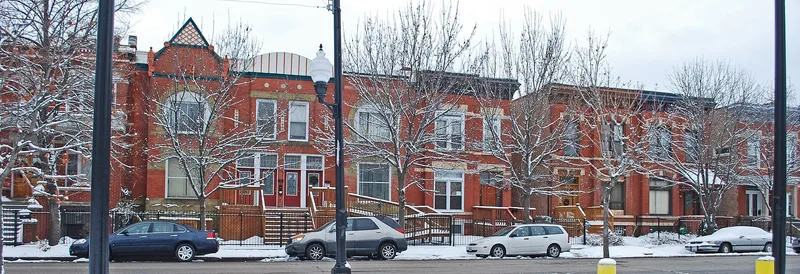
This boundary increase enlarges the Tri-Taylor Historic District on Chicago's West Side by two areas. The northern extension takes in the 500 blocks of Oakley and Claremont and the north side of Harrison Street, with 14 contributing and 5 non-contributing buildings. The Taylor-Oakley extension adds parts of South Oakley and West Taylor Street, with 10 contributing and 3 non-contributing buildings. Most were built in the 1880s and 1890s as brick or stone rowhouses, flats and mixed commercial buildings, with Italianate, Classical Revival and Richardsonian Romanesque detailing. They had been omitted from the 1983 listing through professional oversight. Their inclusion shows the same late nineteenth-century second-settlement growth seen across the neighborhood. It completes streetscapes that had been cut in half. It also sets boundaries at visible barriers: the Eisenhower Expressway, the Medical Center, Ogden Avenue and Western Avenue. The result is a more coherent historic neighborhood of tree-lined, modest-scale residential blocks.
Machine-generated summary. This summary was generated by a language model from the official nomination document and has not been reviewed line by line by an editor. It may contain errors. Check the source document before relying on any detail. Source: nomination document (PDF) · catalog entry. Generated October 2026 (model claude-sonnet-5-5, prompt v1.0-2026-10-29).
| Styles | Italianate, Classical Revival, Richardsonian Romanesque, Romanesque and High Victorian rowhouses, flats and commercial buildings |
|---|---|
| Areas of significance | Architecture, Social History |
| Acreage | 6 |
| Boundary source | NPS cultural-resource GIS polygon |
| Full listing page | Tri-Taylor Historic District (Boundary Increase) (property record) |
What listing means for this property
This is a historic district. Buildings within its boundary are either contributing (they add to the district's significance) or non-contributing. Owners of contributing income-producing buildings can claim the 20% federal rehabilitation tax credit; homeowners should look at state credits. National Register districts impose no design review by themselves; a local historic district ordinance, if one exists, does (the difference explained).
General information, not legal or tax advice. Rules change; confirm with your State Historic Preservation Office or a qualified adviser.