Raymond M. Hilliard Center Historic District

Why it's listed
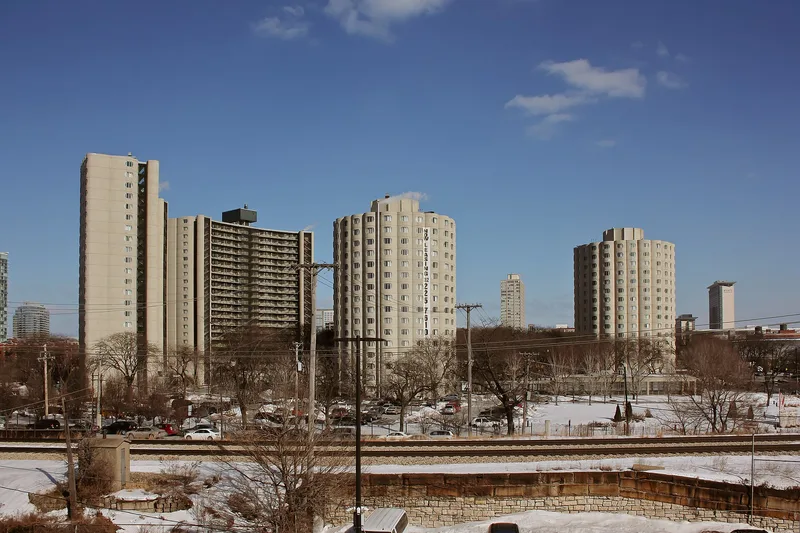
Raymond M. Hilliard Center is a public-housing complex on a 12.5-acre site two miles south of Chicago's Loop. Architect Bertrand Goldberg designed it between 1962 and 1966. It has two 16-story cylindrical towers for senior citizens, two 22-story arc-shaped family buildings, a one-story community center and an open-air concrete amphitheater, with 710 apartments in all. The load-bearing reinforced-concrete walls have reeded bays, vertical striations from wooden slip forms and squared-off elliptical windows. No residential building has a right-angle corner. The buildings cover less than ten percent of the site, leaving lawns, trees and walkways. The complex was listed for its architecture, its community planning and its place in social and political history. Its forms recalled Goldberg's Marina City, and the Chicago Housing Authority hoped that image would improve public housing. Federal officials resisted the design as too expensive and too good for residents, and approval came only after a prolonged struggle. The complex remains largely intact.
Machine-generated summary. This summary was generated by a language model from the official nomination document and has not been reviewed line by line by an editor. It may contain errors. Check the source document before relying on any detail. Source: nomination document (PDF) · catalog entry. Generated October 2026 (model claude-sonnet-5-5, prompt v1.0-2026-10-29).
| Period of significance | 1966 |
|---|---|
| Styles | Modern Movement; neo-expressionism |
| Areas of significance | Architecture, Community Planning and Development, Social History, Politics/Government |
| Acreage | 12.5 |
| Boundary source | NPS cultural-resource GIS polygon |
| Full listing page | Raymond M. Hilliard Center Historic District (property record) |
What listing means for this property
This is a historic district. Buildings within its boundary are either contributing (they add to the district's significance) or non-contributing. Owners of contributing income-producing buildings can claim the 20% federal rehabilitation tax credit; homeowners should look at state credits. National Register districts impose no design review by themselves; a local historic district ordinance, if one exists, does (the difference explained).
General information, not legal or tax advice. Rules change; confirm with your State Historic Preservation Office or a qualified adviser.