Mount Sterling Commercial Historic District

Why it's listed
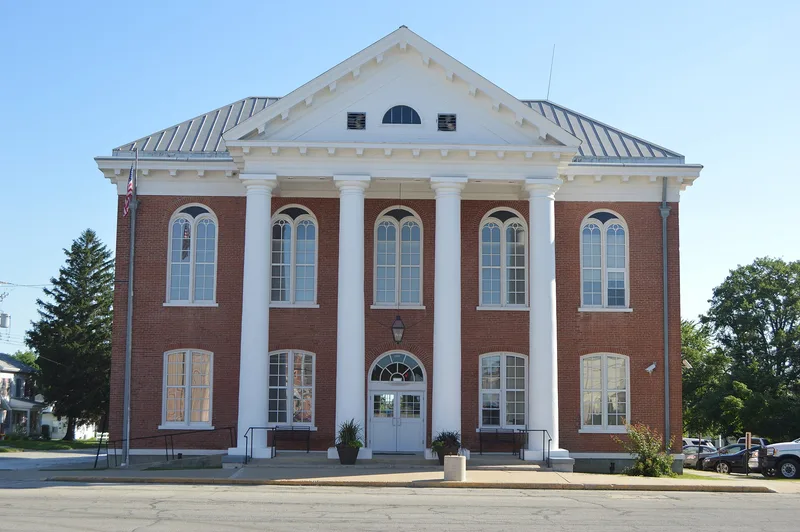
Downtown Mount Sterling's historic core covers four full and four partial quarter-blocks around the Brown County Courthouse. Most buildings are two-story red brick commercial structures from the nineteenth century, all Italianate, with cast iron storefront details, recessed entries, arched upper windows and stamped metal cornices. Their similar height and detail give the district a strong visual rhythm. The dominant building is the 1868 courthouse, an H-shaped brick structure with a Roman Doric portico that was rebuilt from the inside after a 1939 fire. The district also holds a 1915 former hardware store now used as the library, and an early twentieth-century Neo-Classical bank. Mount Sterling was chosen as county seat in 1839 after commissioners weighed local donations for public buildings. The district is significant for showing how county seats and courthouse squares developed as commercial centers, and for its sequence of architectural styles between 1868 and 1920. It still serves as the commercial and governmental center of the county.
Machine-generated summary. This summary was generated by a language model from the official nomination document and has not been reviewed line by line by an editor. It may contain errors. Check the source document before relying on any detail. Source: nomination document (PDF) · catalog entry. Generated October 2026 (model claude-sonnet-5-5, prompt v1.0-2026-10-29).
| Period of significance | 1868-1920 |
|---|---|
| Styles | Italianate commercial, with a Neo-Classical former bank and the 1868 courthouse combining neo-classical and Italianate features |
| Areas of significance | Commerce, Architecture |
| Acreage | 8 |
| Boundary source | NPS cultural-resource GIS polygon |
| Full listing page | Mount Sterling Commercial Historic District (property record) |
What listing means for this property
This is a historic district. Buildings within its boundary are either contributing (they add to the district's significance) or non-contributing. Owners of contributing income-producing buildings can claim the 20% federal rehabilitation tax credit; homeowners should look at state credits. National Register districts impose no design review by themselves; a local historic district ordinance, if one exists, does (the difference explained).
General information, not legal or tax advice. Rules change; confirm with your State Historic Preservation Office or a qualified adviser.