Mount Sterling Commercial Historic District

Why it's listed
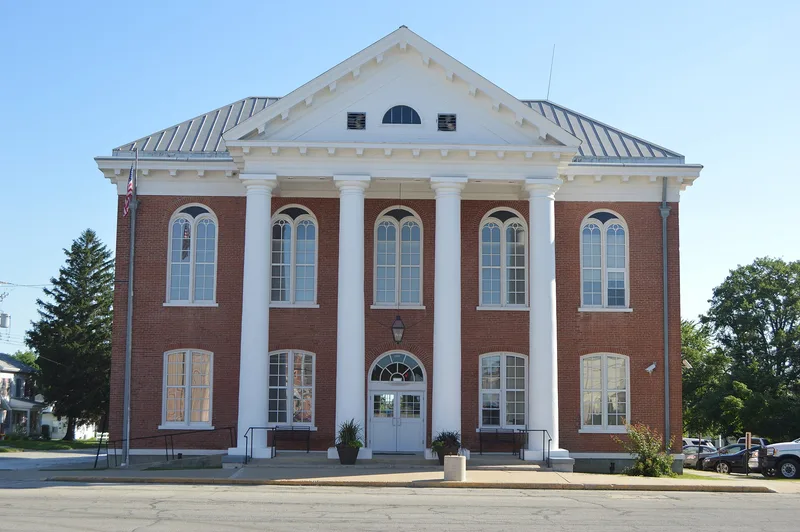
Downtown Mount Sterling's historic core covers four full and four partial quarter-blocks around the Brown County Courthouse. Most buildings are two-story red brick commercial structures from the nineteenth century, all Italianate, with cast iron storefront details, recessed entries, arched upper windows and stamped metal cornices. Their similar height and detail give the district a strong visual rhythm. The dominant building is the 1868 courthouse, an H-shaped brick structure with a Roman Doric portico that was rebuilt from the inside after a 1939 fire. The district also holds a 1915 former hardware store now used as the library, and an early twentieth-century Neo-Classical bank. Mount Sterling was chosen as county seat in 1839 after commissioners weighed local donations for public buildings. The district is significant for showing how county seats and courthouse squares developed as commercial centers, and for its sequence of architectural styles between 1868 and 1920. It still serves as the commercial and governmental center of the county.
Significance in brief: The district is argued to represent the evolution of planned county seats and their courthouse squares as commercial centers (Criterion A). It also illustrates the sequence of architectural preferences in rural midwestern trade centers from 1868 to 1920 (Criterion C). The quality of its architecture reflects Mount Sterling's role as a regional commercial center.
Machine-generated summary. This summary was generated by a language model from the official nomination document and has not been reviewed line by line by an editor. It may contain errors. Check the source document before relying on any detail. Source: nomination document (PDF) · National Archives catalog entry. NRHP reference 87000724, listed May 8, 1987. Summary generated October 2026 (model claude-sonnet-5-5, prompt v1.0-2026-10-29, confidence medium).
Key facts
| Address | Roughly bounded by Brown Co. Courthouse, Alley E of Capitol, South St., and Alley W of Capitol, Mount Sterling |
|---|---|
| County | Brown County |
| Listed | May 8, 1987 |
| Reference number | 87000724 |
| Resource type | District |
| Period of significance | 1868-1920 |
| Architect / builder | Contractor George Rex Gobell (Hagel Hardware building); various original owner-builders including Lewis T. Barry, Frank Clement Curry, Washington Brockman and J.C. Webber |
| Architectural style | Italianate commercial, with a Neo-Classical former bank and the 1868 courthouse combining neo-classical and Italianate features |
| Criteria |
|
| Areas of significance | Commerce, Architecture |
| Level of significance | Local |
| Status (as stated in the nomination) | Downtown remains the commercial hub of the community and county, with most buildings in use; several have altered storefronts and a few first floors are unoccupied. About half of the second floors are apartments and the rest storage. |
| Acreage | 8 |
| Coordinates | 39.99014, -90.99850 (NPS GIS) |
What listing means for this property
This is a historic district. Buildings within its boundary are either contributing (they add to the district's significance) or non-contributing. Owners of contributing income-producing buildings can claim the 20% federal rehabilitation tax credit; homeowners should look at state credits. National Register districts impose no design review by themselves; a local historic district ordinance, if one exists, does (the difference explained).
General information, not legal or tax advice. Rules change; confirm with your State Historic Preservation Office or a qualified adviser.
Sources and further reading
- National Park Service, National Register of Historic Places database (snapshot May 2026), reference 87000724.
- Nomination form (PDF, National Archives) — catalog entry
- Wikipedia article (used for cross-checking only; text not reproduced here)
- Wikidata Q16895455
- This listing as JSON
Last updated October 2026. Found an error? See the editorial policy for how to report it.