Main Street Historic District

The National Park Service has not published a boundary polygon for this district; the map shows the listed properties inside it and the district's reference point.
Why it's listed
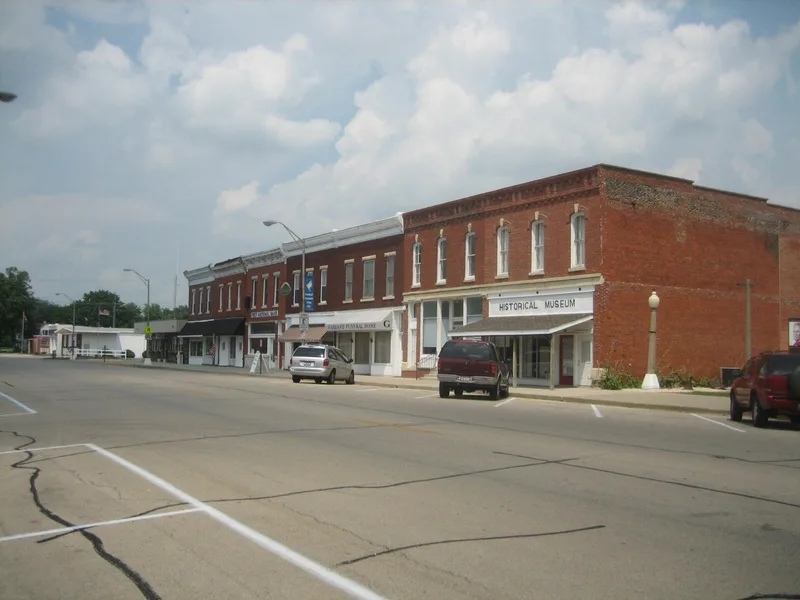
Tampico's Main Street Historic District occupies both sides of the 100 block of South Main Street, the town's traditional business center between Market Street and the railroad tracks. Of its 14 major structures, 10 are classed as significant and three more contribute to its character. Most are two-story brick buildings with uniform setbacks and cornice lines, built after fires and a tornado in the 1870s pushed merchants toward masonry. A building boom followed between 1896 and 1905 as the town served surrounding farms and canal construction workers. The district is also known as the birthplace of Ronald Reagan, who was born on February 6, 1911, in the second-floor apartment at 111 S. Main. His father later clerked at the Pitney variety store at 122-124 S. Main, where the family lived again from 1919 to 1920. A 1970s bank building is the only intrusion, and recent fires have left a vacant lot.
Machine-generated summary. This summary was generated by a language model from the official nomination document and has not been reviewed line by line by an editor. It may contain errors. Check the source document before relying on any detail. Source: nomination document (PDF) · catalog entry. Generated October 2026 (model claude-sonnet-5-5, prompt v1.0-2026-10-29).
| Period of significance | 1871-1920 |
|---|---|
| Areas of significance | Commerce, Exploration/Settlement, Politics/Government, Architecture |
| Acreage | 2.3 |
| Boundary source | not published |
| Full listing page | Main Street Historic District (property record) |
What listing means for this property
This is a historic district. Buildings within its boundary are either contributing (they add to the district's significance) or non-contributing. Owners of contributing income-producing buildings can claim the 20% federal rehabilitation tax credit; homeowners should look at state credits. National Register districts impose no design review by themselves; a local historic district ordinance, if one exists, does (the difference explained).
General information, not legal or tax advice. Rules change; confirm with your State Historic Preservation Office or a qualified adviser.