Lock and Dam No. 21 Historic District

Why it's listed
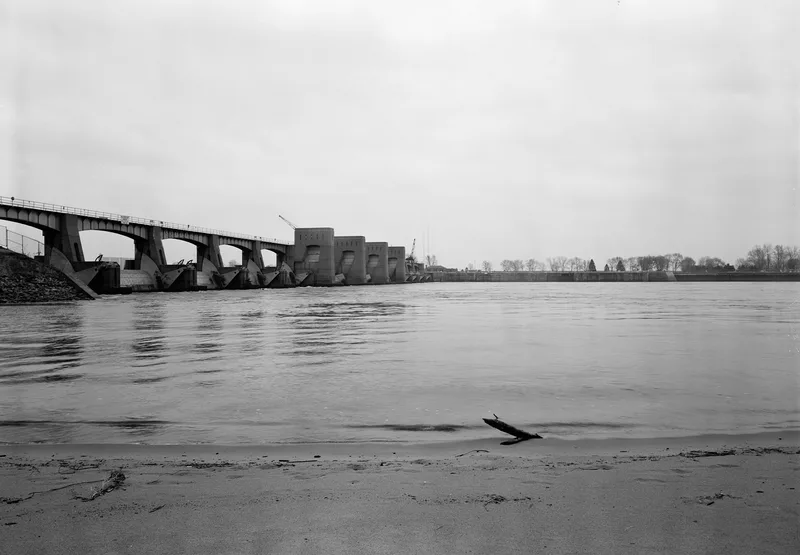
Lock and Dam No. 21 crosses the Upper Mississippi River just downstream from Quincy, Illinois. The 107.46-acre district includes a lift lock with a 10.5-foot lift, an incomplete auxiliary lock, a dam with ten Tainter gates and three submersible roller gates, a central control station, and a landscaped esplanade about 2,000 feet long. Most of it was built between 1933 and 1938 as a federal relief work project, and Quincy was favored in the construction order because of its severe unemployment. Joseph Meltzer Construction built the lock, and McCarthy Improvement Company built the dam, which opened to navigation on July 23, 1938. The roller gates, designed in 1936 to submerge only 4.67 feet, served as the model for later gates on the river system. Guard wall and guide wall additions in 1942 and 1951 addressed outdraft problems at the lock entrance. A major rehabilitation between 1985 and 1994 replaced much of the machinery and added new buildings, yet the district keeps its original layout and open river setting.
Machine-generated summary. This summary was generated by a language model from the official nomination document and has not been reviewed line by line by an editor. It may contain errors. Check the source document before relying on any detail. Source: nomination document (PDF) · catalog entry. Generated October 2026 (model claude-sonnet-5-5, prompt v1.0-2026-10-29).
| Styles | OTHER: lock and dam; NO STYLE: control station; OTHER: machinery |
|---|---|
| Areas of significance | Transportation, Maritime History, Social History, Commerce, Conservation, Economics, Politics/Government, Military |
| Acreage | 107.5 |
| Boundary source | NPS cultural-resource GIS polygon |
| Full listing page | Lock and Dam No. 21 Historic District (property record) |
What listing means for this property
This is a historic district. Buildings within its boundary are either contributing (they add to the district's significance) or non-contributing. Owners of contributing income-producing buildings can claim the 20% federal rehabilitation tax credit; homeowners should look at state credits. National Register districts impose no design review by themselves; a local historic district ordinance, if one exists, does (the difference explained).
General information, not legal or tax advice. Rules change; confirm with your State Historic Preservation Office or a qualified adviser.