Indian Hill Manor and Farm Historic District

Why it's listed
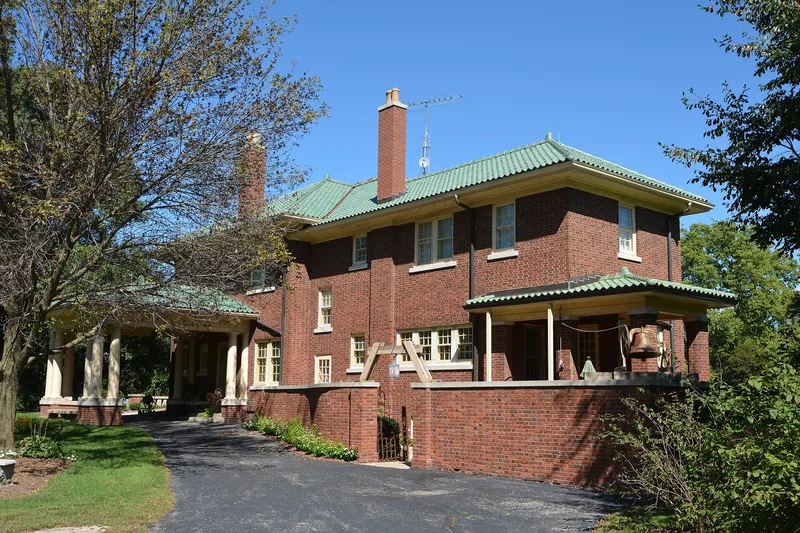
Indian Hill Manor and Farm is a 257.5-acre estate on the south side of the Rock River near Rockford, Illinois, built up by Charles C. Barrett. It has three parts. The first holds a 24-room manor house of 1916-1918, a coach house, a formal garden, woods and a small crop field. The manor is built of multicolored wire-cut brick laid in Flemish bond, with a green ceramic tile hipped roof, an elliptical fanlighted portico and a screened porch facing the garden. Rockford architect Charles W. Bradley designed it as predominantly Colonial Revival, with Craftsman touches such as window groupings, wide eaves, ceiling beams and natural-finish woodwork. Across South Bend Road is a 146.5-acre farm still in operation, with a c. 1875 farmhouse, a summer kitchen, a corn crib, a milk house, two silos and barns. The remaining 49.5 acres of woodland now belong to the Indian Hill Forest Preserve. Together they show an early twentieth-century country estate with its farm.
Machine-generated summary. This summary was generated by a language model from the official nomination document and has not been reviewed line by line by an editor. It may contain errors. Check the source document before relying on any detail. Source: nomination document (PDF) · catalog entry. Generated October 2026 (model claude-sonnet-5-5, prompt v1.0-2026-10-29).
| Styles | Colonial Revival; Craftsman; Other: Hobby Farm |
|---|---|
| Areas of significance | Architecture |
| Acreage | 257.5 |
| Boundary source | NPS cultural-resource GIS polygon |
| Full listing page | Indian Hill Manor and Farm Historic District (property record) |
What listing means for this property
This is a historic district. Buildings within its boundary are either contributing (they add to the district's significance) or non-contributing. Owners of contributing income-producing buildings can claim the 20% federal rehabilitation tax credit; homeowners should look at state credits. National Register districts impose no design review by themselves; a local historic district ordinance, if one exists, does (the difference explained).
General information, not legal or tax advice. Rules change; confirm with your State Historic Preservation Office or a qualified adviser.