Falconer Bungalow Historic District

Why it's listed
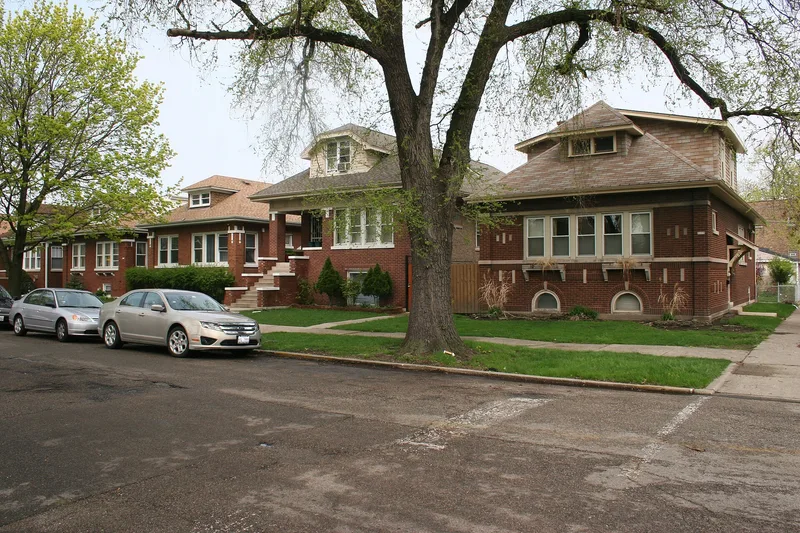
Laid out on former farmland on Chicago's northwest side, this district holds 348 Chicago bungalows plus multi-family buildings, a public school and a church, all built mainly between 1915 and 1931. The one-and-one-half-story brick bungalows share low-pitched roofs, overhanging eaves, banded windows and limestone trim, and they sit on uniform lots with consistent setbacks, which gives the streets a steady rhythm. Early development was driven by two developer and architect teams: George C. Hield with Ernest Braucher, and Edward H. Olsen and Henry Van Vooren with Johan F. Knudson. Smaller builders and families building their own homes followed, with construction peaking in 1923 and 1924. The homes were modest and aimed at working-class buyers employed in nearby industry. The district contains the largest documented group of early open-front-porch bungalows under the Chicago bungalow listing. It was recognized for its role in promoting single-family homeownership and as a well-preserved example of bungalow construction.
Machine-generated summary. This summary was generated by a language model from the official nomination document and has not been reviewed line by line by an editor. It may contain errors. Check the source document before relying on any detail. Source: nomination document (PDF) · catalog entry. Generated October 2026 (model claude-sonnet-5-5, prompt v1.0-2026-10-29).
| Period of significance | 1915-1931 |
|---|---|
| Styles | Other: Chicago Bungalow |
| Areas of significance | Community Planning and Development, Architecture |
| Acreage | 59.2 |
| Boundary source | NPS cultural-resource GIS polygon |
| Full listing page | Falconer Bungalow Historic District (property record) |
What listing means for this property
This is a historic district. Buildings within its boundary are either contributing (they add to the district's significance) or non-contributing. Owners of contributing income-producing buildings can claim the 20% federal rehabilitation tax credit; homeowners should look at state credits. National Register districts impose no design review by themselves; a local historic district ordinance, if one exists, does (the difference explained).
General information, not legal or tax advice. Rules change; confirm with your State Historic Preservation Office or a qualified adviser.