Elm Street Court

The National Park Service has not published a boundary polygon for this district; the map shows the listed properties inside it and the district's reference point.
Why it's listed
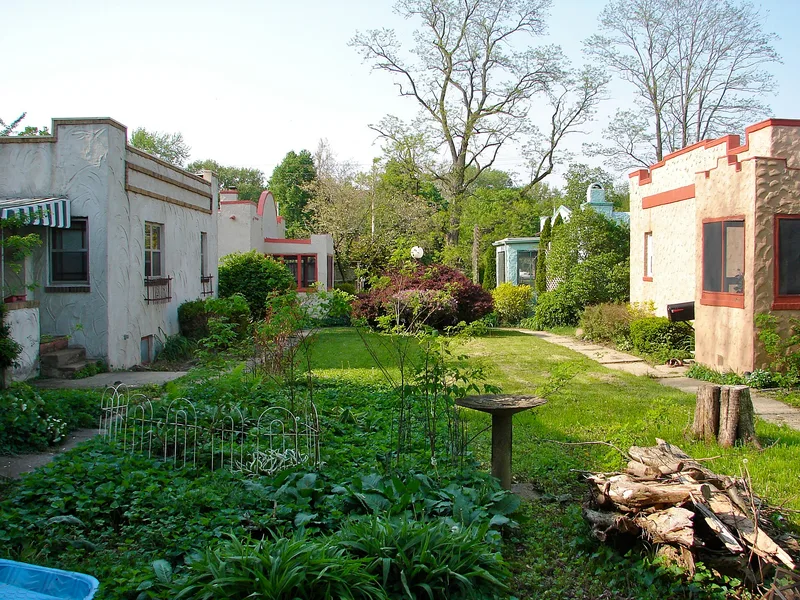
Elm Street Court is a group of eight single-story bungalows arranged around a landscaped courtyard in one of Urbana's oldest residential areas, a couple of blocks west of downtown. Four houses line each side of a courtyard roughly 30 by 200 feet. Built in the 1920s in the Spanish Colonial Revival style, they have stucco walls, parapeted facades, iron window grilles, header brick trim and some red tile pent roofs. Each has two bedrooms, a brick chimney and a basement, yet each differs in parapet shape and stucco finish. Craftsman-style muntin patterns appear in the original windows and doors. The courtyard, a concrete birdbath, an ornamental lamppost and a freestanding concrete entrance at the north end contribute to the district. The district was listed for architecture because it is an unusual Midwestern example of California-style courtyard housing, and because the houses keep their original character. The rear garages were demolished in 1999, but the homes are still lived in.
Machine-generated summary. This summary was generated by a language model from the official nomination document and has not been reviewed line by line by an editor. It may contain errors. Check the source document before relying on any detail. Source: nomination document (PDF) · catalog entry. Generated October 2026 (model claude-sonnet-5-5, prompt v1.0-2026-10-29).
| Period of significance | 1926 |
|---|---|
| Styles | Spanish Colonial Revival |
| Areas of significance | Architecture |
| Acreage | 1.2 |
| Boundary source | not published |
| Full listing page | Elm Street Court (property record) |
What listing means for this property
This is a historic district. Buildings within its boundary are either contributing (they add to the district's significance) or non-contributing. Owners of contributing income-producing buildings can claim the 20% federal rehabilitation tax credit; homeowners should look at state credits. National Register districts impose no design review by themselves; a local historic district ordinance, if one exists, does (the difference explained).
General information, not legal or tax advice. Rules change; confirm with your State Historic Preservation Office or a qualified adviser.