Danville Branch, National Home for Disabled Volunteer Soldiers Historic District

Why it's listed
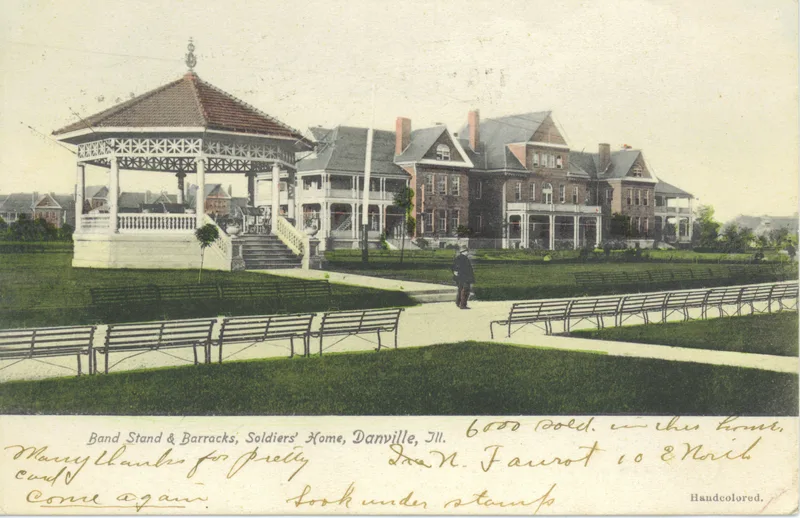
Located on the eastern edge of Danville, Illinois, this roughly 300-acre campus began as the Danville Branch of the National Home for Disabled Volunteer Soldiers. Congress authorized it in 1897 after lobbying by local Congressman Joseph Cannon, construction started in 1898, and the first veteran was admitted that October. The district holds 70 buildings, of which 47 contribute, along with a thirty-acre national cemetery. Most buildings are red brick with simple sandstone details and Georgian Revival influence, including ten similar two-and-a-half-story wards, a mess hall with a clock cupola, and staff quarters. The 1905 Carnegie Library is the most ornate building, in Classical Revival style. Winding roads lead past a golf course, gardens, a pond and farm fields that once served therapeutic purposes. The Home was designed as a planned community offering shelter, education, training and employment. Today the Veterans Affairs medical center and a community college share the grounds, and alterations to historic buildings have been minimal.
Machine-generated summary. This summary was generated by a language model from the official nomination document and has not been reviewed line by line by an editor. It may contain errors. Check the source document before relying on any detail. Source: nomination document (PDF) · catalog entry. Generated October 2026 (model claude-sonnet-5-5, prompt v1.0-2026-10-29).
| Styles | Colonial Revival, Classical Revival, Late Gothic Revival (Georgian Revival influence) |
|---|---|
| Areas of significance | Health/Medicine, Architecture |
| Acreage | 297 |
| Boundary source | NPS cultural-resource GIS polygon |
| Full listing page | Danville Branch, National Home for Disabled Volunteer Soldiers Historic District (property record) |
What listing means for this property
This is a historic district. Buildings within its boundary are either contributing (they add to the district's significance) or non-contributing. Owners of contributing income-producing buildings can claim the 20% federal rehabilitation tax credit; homeowners should look at state credits. National Register districts impose no design review by themselves; a local historic district ordinance, if one exists, does (the difference explained).
General information, not legal or tax advice. Rules change; confirm with your State Historic Preservation Office or a qualified adviser.