Christian Hill Historic District

Why it's listed
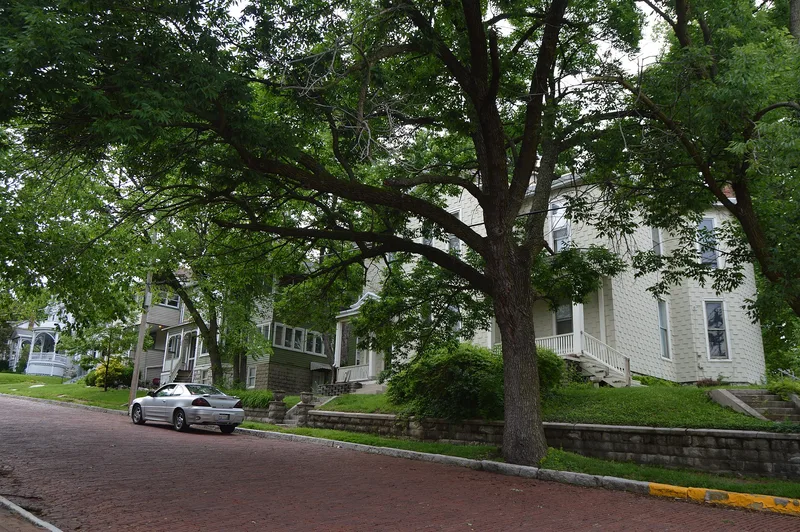
Christian Hill is a residential neighborhood on the Mississippi River bluffs just west of downtown Alton, Illinois. Its boundaries follow the hill itself, and its streets bend to the topography, with brick paving, limestone retaining walls and steep grades. Of 274 structures, 72 were judged especially significant, and most of the rest predate World War I. The district was listed for its concentration of pre-Civil War buildings, many in the Federal style dating from the 1830s, alongside Italianate, Second Empire and Queen Anne houses built up to about 1910. Development began in the early 1830s, when the state penitentiary opened nearby. The neighborhood took its name after the Catholic church moved up the hill in the 1850s and became the cathedral. The site of Elijah Lovejoy's 1837 murder lies at its edge. Few changes have occurred over the last half century, and restoration work has been extensive.
Machine-generated summary. This summary was generated by a language model from the official nomination document and has not been reviewed line by line by an editor. It may contain errors. Check the source document before relying on any detail. Source: nomination document (PDF) · catalog entry. Generated October 2026 (model claude-sonnet-5-5, prompt v1.0-2026-10-29).
| Styles | Federal, Greek Revival transition, Italianate, Second Empire, Queen Anne, Romanesque Revival |
|---|---|
| Areas of significance | Industry, Historic - Non-Aboriginal, Politics/Government, Architecture, Religion, Social History |
| Acreage | 106 |
| Boundary source | NPS cultural-resource GIS polygon |
| Full listing page | Christian Hill Historic District (property record) |
What listing means for this property
This is a historic district. Buildings within its boundary are either contributing (they add to the district's significance) or non-contributing. Owners of contributing income-producing buildings can claim the 20% federal rehabilitation tax credit; homeowners should look at state credits. National Register districts impose no design review by themselves; a local historic district ordinance, if one exists, does (the difference explained).
General information, not legal or tax advice. Rules change; confirm with your State Historic Preservation Office or a qualified adviser.