Belvidere South State Street Historic District

Why it's listed
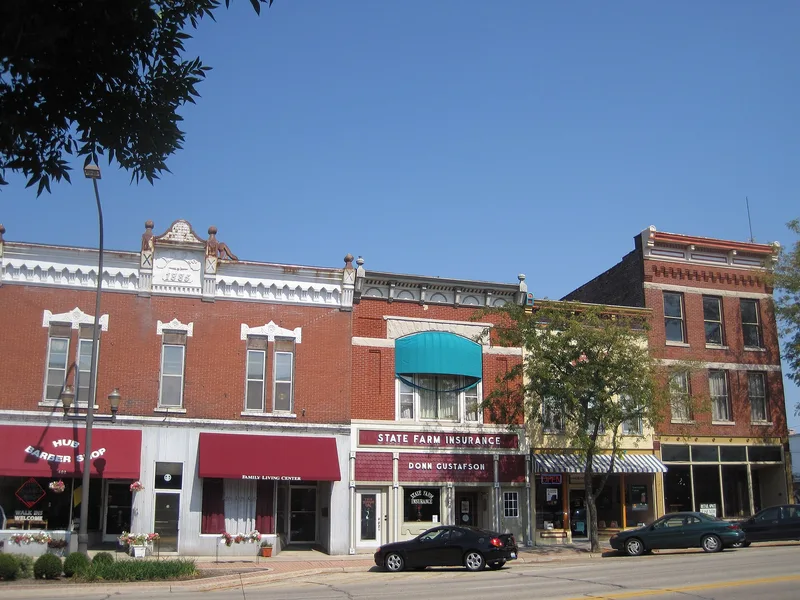
South State Street in Belvidere, Illinois, is a compact commercial district of 16 acres, covering five blocks between Pearl Street and Whitney Boulevard. It holds 50 properties, 44 of them contributing, most of them attached brick storefronts with apartments or meeting halls above. Development shifted here after the Chicago and Northwestern Railroad reached the area in 1851, and the oldest building, P. Curtis's Block, dates to 1852. Italianate buildings from the late nineteenth century give the district its character, with pressed-metal cornices, stone lintels, oriel windows and some surviving cast iron storefronts. Examples include the 1885 Odd Fellows building and the Commerce Building, designed by Lewis H. Sturges. City hall, a community center, housing and a previously listed school complex add civic and social uses. The district was recognized as a commercial center from 1852 to 1962, and its streetscapes have changed little since the mid-1950s. Newer or heavily altered buildings are classed as noncontributing.
Machine-generated summary. This summary was generated by a language model from the official nomination document and has not been reviewed line by line by an editor. It may contain errors. Check the source document before relying on any detail. Source: nomination document (PDF) · catalog entry. Generated October 2026 (model claude-sonnet-5-5, prompt v1.0-2026-10-29).
| Period of significance | 1852-1962 |
|---|---|
| Styles | Late Victorian: Italianate; Late 19th/Early 20th C: Commercial Style; Prairie School; Modern Movement: Art Deco |
| Areas of significance | Commerce, Architecture |
| Acreage | 16 |
| Boundary source | NPS cultural-resource GIS polygon |
| Full listing page | Belvidere South State Street Historic District (property record) |
What listing means for this property
This is a historic district. Buildings within its boundary are either contributing (they add to the district's significance) or non-contributing. Owners of contributing income-producing buildings can claim the 20% federal rehabilitation tax credit; homeowners should look at state credits. National Register districts impose no design review by themselves; a local historic district ordinance, if one exists, does (the difference explained).
General information, not legal or tax advice. Rules change; confirm with your State Historic Preservation Office or a qualified adviser.