Woodlawn Historic District

The National Park Service has not published a boundary polygon for this district; the map shows the listed properties inside it and the district's reference point.
Why it's listed
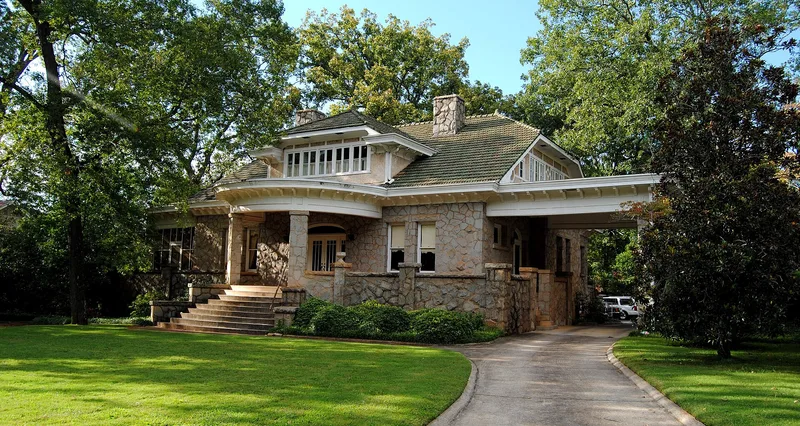
Woodlawn Avenue in Athens, Georgia, is lined with a compact group of early 20th-century houses, one to two stories tall and built of brick, wood, stucco and stone. Most are Bungalow/Craftsman in form, with gabled fronts, columned porches and bracketed eaves, while others add Colonial Revival, Classical Revival or Tudor Revival features. One brick Classical Revival house was designed by Athens architect Fred Orr. The land was part of the estate of Mrs. N. Adams until it was platted in 1909 as the Rutherford Survey and then subdivided further; most houses went up between 1916 and the early 1920s. The straight street, rectangular lots, shared setbacks and large hardwood trees give the area a park-like feel. It is one of only two Athens districts made up entirely of early 20th-century architecture, and it shows a family estate gradually becoming a neighborhood. Early residents included many professionals and University of Georgia faculty and staff.
Machine-generated summary. This summary was generated by a language model from the official nomination document and has not been reviewed line by line by an editor. It may contain errors. Check the source document before relying on any detail. Source: nomination document (PDF) · catalog entry. Generated October 2026 (model claude-sonnet-5-5, prompt v1.0-2026-10-29).
| Period of significance | 1916-1926 (development) |
|---|---|
| Styles | Late 19th and early 20th century: Bungalow/Craftsman, Colonial Revival, Classical Revival, Tudor Revival |
| Areas of significance | Community Planning and Development, Architecture |
| Acreage | 8 |
| Boundary source | not published |
| Full listing page | Woodlawn Historic District (property record) |
What listing means for this property
This is a historic district. Buildings within its boundary are either contributing (they add to the district's significance) or non-contributing. Owners of contributing income-producing buildings can claim the 20% federal rehabilitation tax credit; homeowners should look at state credits. National Register districts impose no design review by themselves; a local historic district ordinance, if one exists, does (the difference explained).
General information, not legal or tax advice. Rules change; confirm with your State Historic Preservation Office or a qualified adviser.