Wesleyan Methodist Campground and Tabernacle

The National Park Service has not published a boundary polygon for this district; the map shows the listed properties inside it and the district's reference point.
Why it's listed
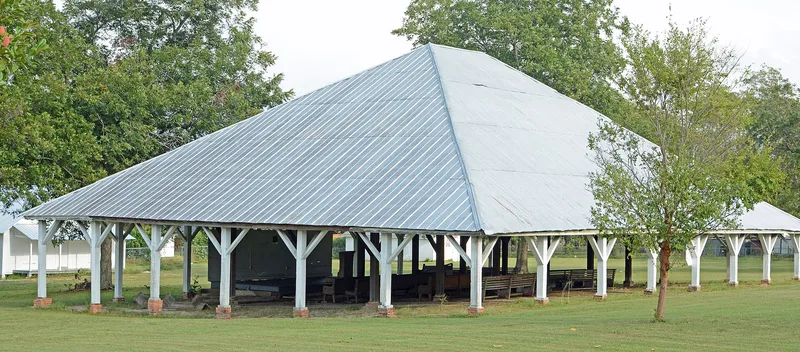
Wesleyan Methodist Campground and Tabernacle is a three-acre camp meeting site a few blocks from downtown Ashburn, Georgia. Its main feature is a pine post-and-beam tabernacle built in 1902 by R. V. Ayers and church members. The tabernacle has a large hipped metal roof, seats about 400 people, and is open on three sides, with only the wall behind the platform enclosed. Original movable pews remain. A frame kitchen and a sleeping room with eight small chambers, both from about 1914, complete the historic group; two buildings from about 1984 do not contribute. The campground is notable as an urban example in a state where such sites were usually rural, and as a surviving place of the Wesleyan Methodist faith, uncommon in Georgia. It hosted annual summer meetings for decades, drawing several hundred people. The City of Ashburn bought it in 1984 to prevent demolition, and it serves as a community meeting place.
Machine-generated summary. This summary was generated by a language model from the official nomination document and has not been reviewed line by line by an editor. It may contain errors. Check the source document before relying on any detail. Source: nomination document (PDF) · catalog entry. Generated October 2026 (model claude-sonnet-5-5, prompt v1.0-2026-10-29).
| Period of significance | 1902-1948 |
|---|---|
| Styles | OTHER/tabernacle |
| Areas of significance | Architecture, Religion |
| Acreage | 3 |
| Boundary source | not published |
| Full listing page | Wesleyan Methodist Campground and Tabernacle (property record) |
What listing means for this property
This is a historic district. Buildings within its boundary are either contributing (they add to the district's significance) or non-contributing. Owners of contributing income-producing buildings can claim the 20% federal rehabilitation tax credit; homeowners should look at state credits. National Register districts impose no design review by themselves; a local historic district ordinance, if one exists, does (the difference explained).
General information, not legal or tax advice. Rules change; confirm with your State Historic Preservation Office or a qualified adviser.