Wesleyan College Historic District

Why it's listed
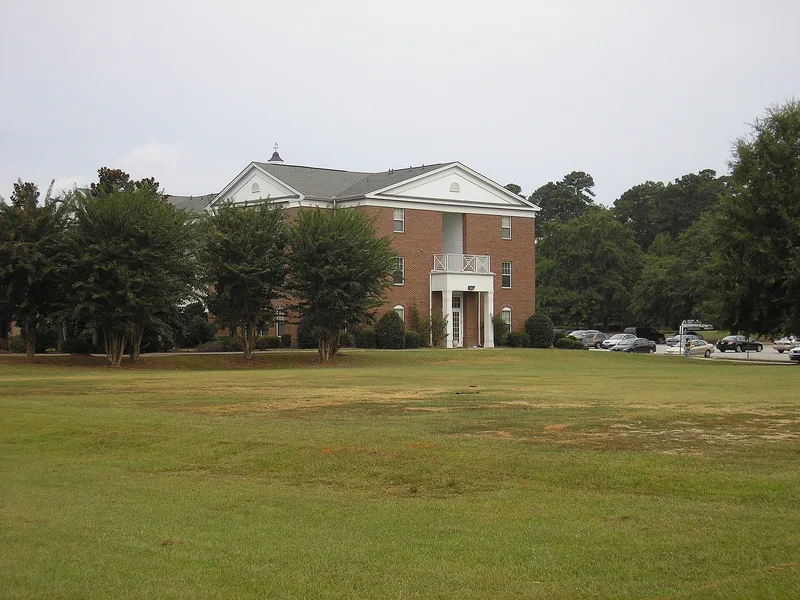
Wesleyan College occupies a 200-acre campus in the Rivoli neighborhood on the northern edge of Macon, Georgia. The school, founded in 1836 as Georgia Female College, moved from downtown Macon to this site in 1927-1928 after outgrowing its original location. The new campus was laid out as a single design, with red-brick Georgian Revival buildings by Walker & Weeks arranged around an open quadrangle landscaped by the Atlanta firm of J. Leon Hoffman. Highlights include the Olive Swann Porter Building, with a portico modeled on George Washington's Mount Vernon, and the Candler Library, designed by Philip Shutze. The Depression delayed further building until the mid-1950s, when architect W. Elliott Dunwody added Porter Fine Arts, Huckabee Hall and Jones Hall in keeping with the original plan. Later buildings through 1968 completed that plan. Roughly half the land remains forest preserve. The district is notable for its architectural consistency and its link to a pioneering women's college.
Machine-generated summary. This summary was generated by a language model from the official nomination document and has not been reviewed line by line by an editor. It may contain errors. Check the source document before relying on any detail. Source: nomination document (PDF) · catalog entry. Generated October 2026 (model claude-sonnet-5-5, prompt v1.0-2026-10-29).
| Styles | Georgian Revival |
|---|---|
| Areas of significance | Architecture, Community Planning and Development, Education, Landscape Architecture |
| Acreage | 200 |
| Boundary source | NPS cultural-resource GIS polygon |
| Full listing page | Wesleyan College Historic District (property record) |
What listing means for this property
This is a historic district. Buildings within its boundary are either contributing (they add to the district's significance) or non-contributing. Owners of contributing income-producing buildings can claim the 20% federal rehabilitation tax credit; homeowners should look at state credits. National Register districts impose no design review by themselves; a local historic district ordinance, if one exists, does (the difference explained).
General information, not legal or tax advice. Rules change; confirm with your State Historic Preservation Office or a qualified adviser.