St. Marys Historic District

The National Park Service has not published a boundary polygon for this district; the map shows the listed properties inside it and the district's reference point.
Why it's listed
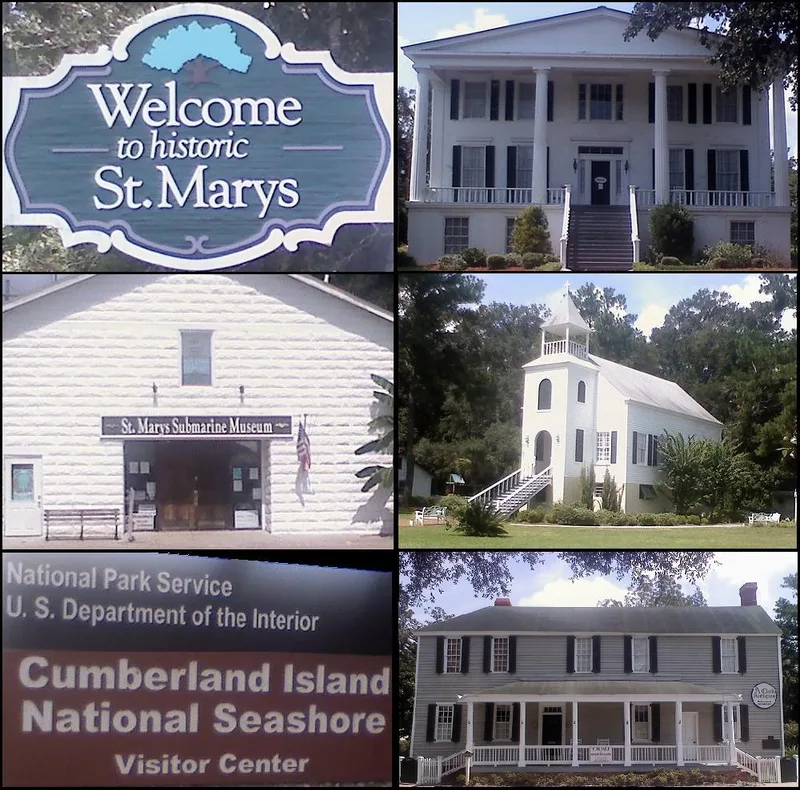
St. Marys is a small seaport town on the north bank of the St. Marys River in southeastern Georgia, laid out in a square grid in 1788 with six public squares. The historic district covers about 230 acres and keeps the original street plan almost unchanged. Osborne Street, the main avenue, holds the Washington Oak and Pump of 1799, the Archibald Clarke House of 1801-1805, the Rudolph House and the 1914 Riverview Hotel. Other streets contain the Pratt-Gillican House of 1825, an early raised cottage, and the Presbyterian Church of 1808, known for a bell cast by Paul Revere. Oak Grove Cemetery holds graves dating from 1801. The town was a busy port from 1787 to the mid-1840s, trading in lumber, fruit, vegetables and sea-island cotton, and twice served as Camden County seat. It was listed as an example of an early port city with good early houses and churches.
Machine-generated summary. This summary was generated by a language model from the official nomination document and has not been reviewed line by line by an editor. It may contain errors. Check the source document before relying on any detail. Source: nomination document (PDF) · catalog entry. Generated October 2026 (model claude-sonnet-5-5, prompt v1.0-2026-10-29).
| Styles | Plantation plain, Sand Hills raised cottage and other early Georgia residential and religious buildings |
|---|---|
| Areas of significance | Community Planning and Development, Exploration/Settlement, Architecture |
| Acreage | 230 |
| Boundary source | not published |
| Full listing page | St. Marys Historic District (property record) |
What listing means for this property
This is a historic district. Buildings within its boundary are either contributing (they add to the district's significance) or non-contributing. Owners of contributing income-producing buildings can claim the 20% federal rehabilitation tax credit; homeowners should look at state credits. National Register districts impose no design review by themselves; a local historic district ordinance, if one exists, does (the difference explained).
General information, not legal or tax advice. Rules change; confirm with your State Historic Preservation Office or a qualified adviser.