Smith, Archibald, House

The National Park Service has not published a boundary polygon for this district; the map shows the listed properties inside it and the district's reference point.
Why it's listed
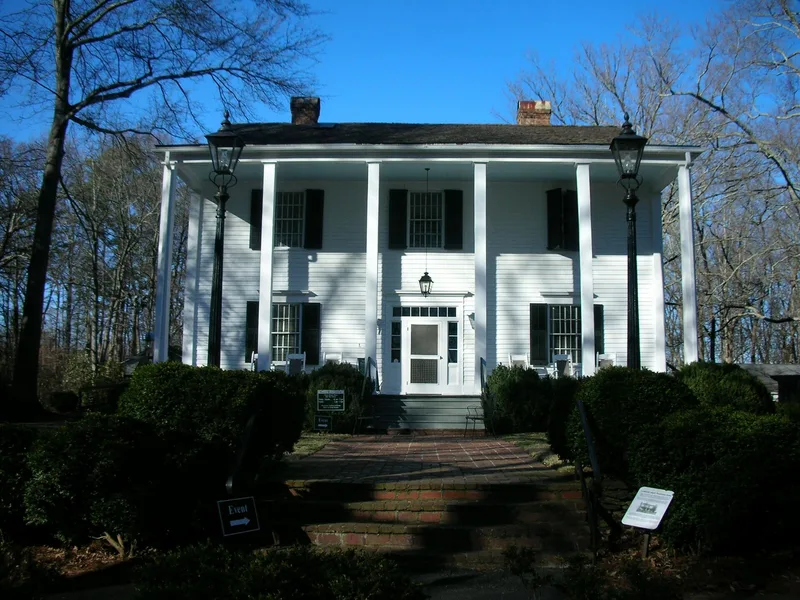
This property in Roswell, Georgia, is a farmstead centered on a two-story, three-bay vernacular Georgian house built in 1844-1845 for Archibald Smith and his wife Anne Magill Smith. Local carpenter Denny Gentry built the heavy timber-framed house, which has clapboard siding, a wood shingle roof, a stone and brick foundation, and a simple Greek Revival entrance. Around it stand thirteen contributing outbuildings and structures, including a kitchen, corn crib, well, springhouse, carriage house and cottages, plus four noncontributing modern or rebuilt elements. The house is much plainer than the large mansions built in town by other founding families, because Smith kept to farming and agricultural experimentation. In the 1940s, descendant and architect Arthur W. Smith added the full-height portico, wiring, plumbing and heating. The City of Roswell restored parts of the property and opened it as a house museum in 1992.
Machine-generated summary. This summary was generated by a language model from the official nomination document and has not been reviewed line by line by an editor. It may contain errors. Check the source document before relying on any detail. Source: nomination document (PDF) · catalog entry. Generated October 2026 (model claude-sonnet-5-5, prompt v1.0-2026-10-29).
| Styles | OTHER/Georgian House (vernacular Georgian with Greek Revival details) |
|---|---|
| Areas of significance | Architecture, Agriculture, Exploration/Settlement |
| Acreage | 4.9 |
| Boundary source | not published |
| Full listing page | Smith, Archibald, House (property record) |
What listing means for this property
This is a historic district. Buildings within its boundary are either contributing (they add to the district's significance) or non-contributing. Owners of contributing income-producing buildings can claim the 20% federal rehabilitation tax credit; homeowners should look at state credits. National Register districts impose no design review by themselves; a local historic district ordinance, if one exists, does (the difference explained).
General information, not legal or tax advice. Rules change; confirm with your State Historic Preservation Office or a qualified adviser.