Royston Commercial Historic District

Why it's listed
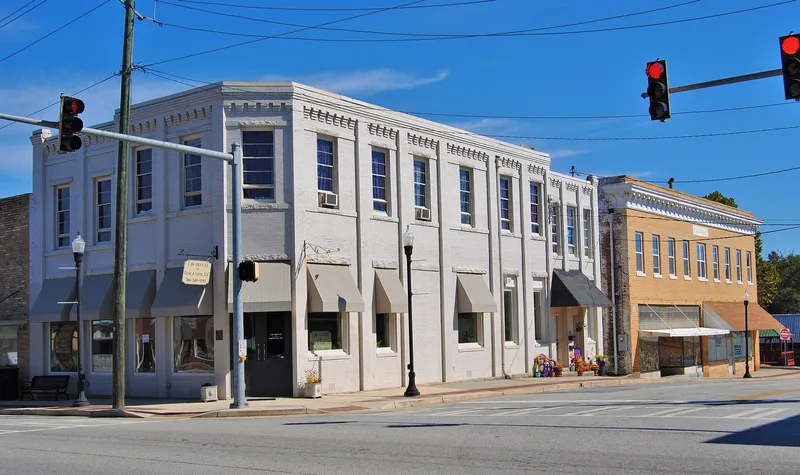
Royston's historic commercial center occupies about six acres between Church Street and the Southern Railroad tracks in Franklin County, Georgia. Its small lots hold mostly one- and two-story brick stores with party walls, along with a wood-framed depot, a lumber company building, and a concrete-block post office. Details such as corbeled cornices, brackets, sign plates and large display windows reflect modest late Victorian and early twentieth-century commercial design, produced by local builders who each gave their corbeled cornices a distinct signature. The Dorough Building, still largely intact inside and out, is a highlight. The town was laid out by W. A. Royston after he granted the railroad an easement in 1874, and it grew into a busy cotton marketing center. Building permits, a Board of Trade formed in 1913, and later zoning powers show early planning efforts. The depot and early automobile facilities recall its ties to the railroad and the Bankhead Highway.
Machine-generated summary. This summary was generated by a language model from the official nomination document and has not been reviewed line by line by an editor. It may contain errors. Check the source document before relying on any detail. Source: nomination document (PDF) · catalog entry. Generated October 2026 (model claude-sonnet-5-5, prompt v1.0-2026-10-29).
| Period of significance | 1875-1935 |
|---|---|
| Styles | Late Victorian and Early 20th Century Commercial, with Gothic, Romanesque, Classical/Colonial Revival and Craftsman detailing |
| Areas of significance | Community Planning and Development, Commerce, Transportation, Architecture |
| Acreage | 6 |
| Boundary source | NPS cultural-resource GIS polygon |
| Full listing page | Royston Commercial Historic District (property record) |
What listing means for this property
This is a historic district. Buildings within its boundary are either contributing (they add to the district's significance) or non-contributing. Owners of contributing income-producing buildings can claim the 20% federal rehabilitation tax credit; homeowners should look at state credits. National Register districts impose no design review by themselves; a local historic district ordinance, if one exists, does (the difference explained).
General information, not legal or tax advice. Rules change; confirm with your State Historic Preservation Office or a qualified adviser.