Quitman Historic District

Why it's listed
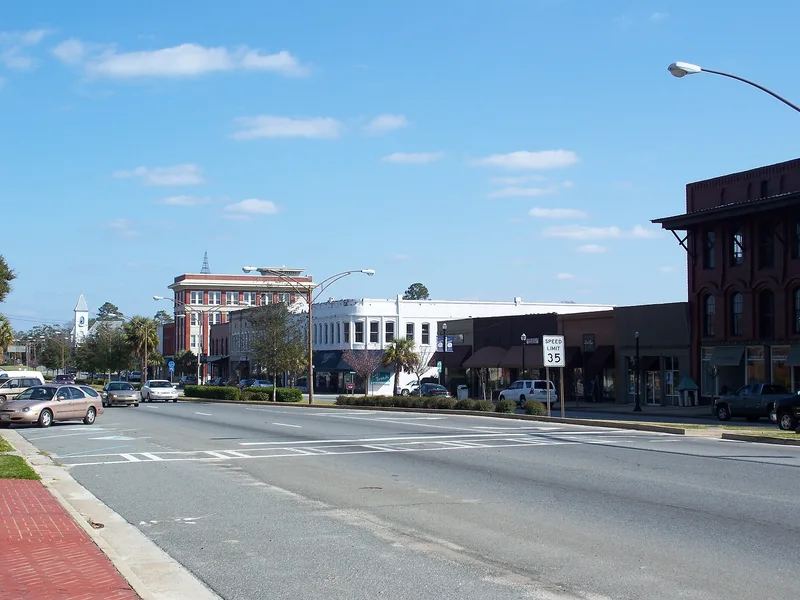
Quitman is a small south Georgia city planned in 1859 as the seat of newly created Brooks County. Its historic core keeps the original layout, with two wide avenues, Screven Street and Court Street, meeting at the courthouse square and lined with landscaped center parks. The district includes about eight blocks of one- to three-story brick commercial buildings sharing party walls, among them an 1898 bank, a 1929 theatre and an 1887 opera house now used as city hall. Residential streets hold Greek Revival cottages, Queen Anne and Neoclassical houses, bungalows, and modest tenant housing built for mill and sawmill workers. In the southeast, near the railroad, stand an 1871 three-story cotton mill and an 1899 mill, reflecting the agricultural industries of small South Georgia towns. The district was listed for its roles in commerce and industry and for the survival of its nineteenth and early twentieth century fabric, though some modern buildings intrude.
Machine-generated summary. This summary was generated by a language model from the official nomination document and has not been reviewed line by line by an editor. It may contain errors. Check the source document before relying on any detail. Source: nomination document (PDF) · catalog entry. Generated October 2026 (model claude-sonnet-5-5, prompt v1.0-2026-10-29).
| Styles | Mixed styles including Greek Revival, Queen Anne, Victorian Eclectic, Neoclassical, Eclectic Romanesque, and Georgian plan houses |
|---|---|
| Areas of significance | Industry, Community Planning and Development, Landscape Architecture, Commerce, Transportation, Architecture |
| Acreage | 417 |
| Boundary source | NPS cultural-resource GIS polygon |
| Full listing page | Quitman Historic District (property record) |
What listing means for this property
This is a historic district. Buildings within its boundary are either contributing (they add to the district's significance) or non-contributing. Owners of contributing income-producing buildings can claim the 20% federal rehabilitation tax credit; homeowners should look at state credits. National Register districts impose no design review by themselves; a local historic district ordinance, if one exists, does (the difference explained).
General information, not legal or tax advice. Rules change; confirm with your State Historic Preservation Office or a qualified adviser.