Oglethorpe University Historic District

The National Park Service has not published a boundary polygon for this district; the map shows the listed properties inside it and the district's reference point.
Why it's listed
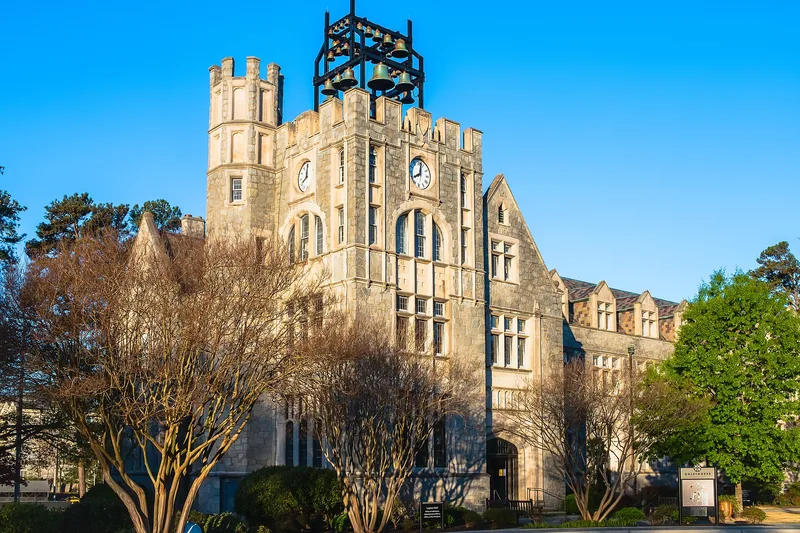
Along Peachtree Road in north Atlanta, the historic core of Oglethorpe University looks much like an English college. Blue Elberton granite buildings with Indiana limestone trim, slate roofs and Gothic tracery surround a landscaped quadrangle laid out in 1914 by Charles W. Leavitt, Jr. Morgan and Dillon designed the buildings, which include Phoebe Hearst Memorial Hall (1915), Lupton Hall with its clock tower (completed 1926), Lowry Hall (1926, expanded in 1991-92 as the library) and Hermance Stadium (first section dedicated 1929). Beneath Hearst Hall lies the Crypt of Civilization, a time capsule sealed in 1940. The campus was the work of Dr. Thornwell Jacobs, who refounded the university in Atlanta as a memorial to James Oglethorpe, Georgia's founder. The district was essentially complete by 1929 and retains its architectural integrity despite later changes, including a 1987 gatehouse and some modern buildings outside its boundaries. It remains an active campus.
Machine-generated summary. This summary was generated by a language model from the official nomination document and has not been reviewed line by line by an editor. It may contain errors. Check the source document before relying on any detail. Source: nomination document (PDF) · catalog entry. Generated October 2026 (model claude-sonnet-5-5, prompt v1.0-2026-10-29).
| Styles | Late 19th and 20th Century Revivals/Late Gothic Revival, Collegiate Gothic |
|---|---|
| Areas of significance | Architecture, Education, Landscape Architecture, Social History |
| Acreage | 9 |
| Boundary source | not published |
| Full listing page | Oglethorpe University Historic District (property record) |
What listing means for this property
This is a historic district. Buildings within its boundary are either contributing (they add to the district's significance) or non-contributing. Owners of contributing income-producing buildings can claim the 20% federal rehabilitation tax credit; homeowners should look at state credits. National Register districts impose no design review by themselves; a local historic district ordinance, if one exists, does (the difference explained).
General information, not legal or tax advice. Rules change; confirm with your State Historic Preservation Office or a qualified adviser.