North Patterson Street Historic District

The National Park Service has not published a boundary polygon for this district; the map shows the listed properties inside it and the district's reference point.
Why it's listed
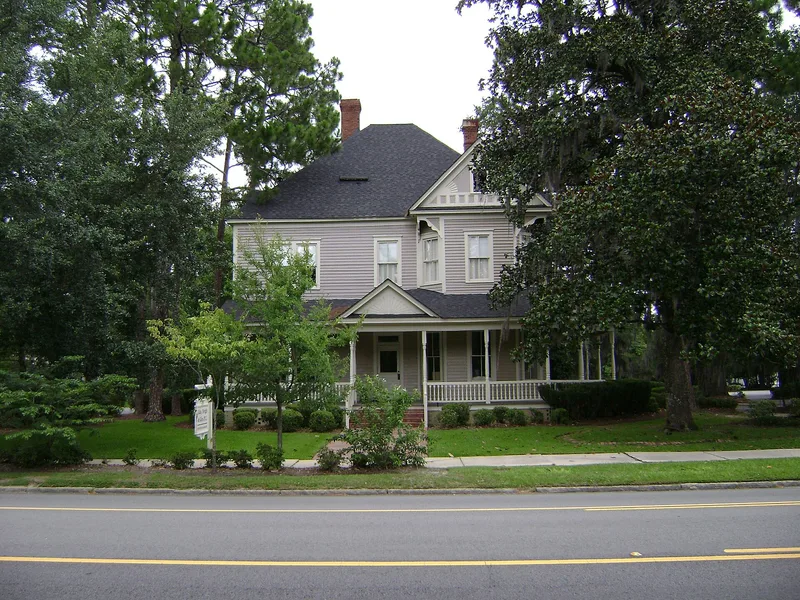
Fourteen large houses line North Patterson Street about a mile north of downtown Valdosta, Georgia, forming a district of roughly 8.3 acres. Nearly all were built between 1899 and 1909, when the city was expanding northward during a boom that ran from 1888 to 1918. Most are wood-framed with high hipped roofs and gables, and their styles include Victorian Eclectic, Eastlake and Neoclassical, with a stuccoed 1919 house at 1100 designed by Lloyd Greer. Lots are uniform, houses sit at similar setbacks, and many front yards are raised behind low retaining walls. The district matters for its architecture and for its residents, who included lumbermen, merchants, a banker, physicians, a sheriff, judges and a mayor. Several served on school boards, city council or the Board of Health, and one physician co-founded the county's principal hospital. Commercial buildings now mark both ends of the district.
Machine-generated summary. This summary was generated by a language model from the official nomination document and has not been reviewed line by line by an editor. It may contain errors. Check the source document before relying on any detail. Source: nomination document (PDF) · catalog entry. Generated October 2026 (model claude-sonnet-5-5, prompt v1.0-2026-10-29).
| Period of significance | 1899-1919 |
|---|---|
| Styles | Turn-of-the-century Neoclassical, Victorian Eclectic, Eastlake, Colonial Revival and Bungalow |
| Areas of significance | Architecture |
| Acreage | 8.3 |
| Boundary source | not published |
| Full listing page | North Patterson Street Historic District (property record) |
What listing means for this property
This is a historic district. Buildings within its boundary are either contributing (they add to the district's significance) or non-contributing. Owners of contributing income-producing buildings can claim the 20% federal rehabilitation tax credit; homeowners should look at state credits. National Register districts impose no design review by themselves; a local historic district ordinance, if one exists, does (the difference explained).
General information, not legal or tax advice. Rules change; confirm with your State Historic Preservation Office or a qualified adviser.