Nevil, Dr. John C., House

The National Park Service has not published a boundary polygon for this district; the map shows the listed properties inside it and the district's reference point.
Why it's listed
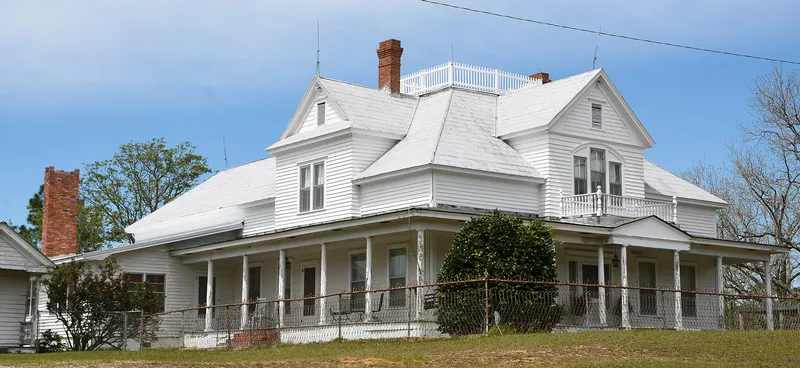
This nine-acre farm complex on US 301 near Register, Georgia, centers on a two-story frame house that began in 1902 as a three-room dwelling for Dr. John C. Nevil. Around 1910 local builder Butler Barr added a larger front section, and the older house was moved and attached to the rear. The result has a wrap-around porch, a widow's walk, scalloped gable shingles, corbelled chimneys and a central hall with a lattice screen. A one-room doctor's office, which also served as a rural pharmacy, and a smokehouse survive as historic outbuildings, along with a pecan grove planted in the early 1930s. Nevil practiced medicine here for 53 years, serving roughly sixteen square miles between Register and Claxton, first by horse and buggy, while also farming. The property was recognized for its architecture and for its link to rural medical practice in the early twentieth century South. The house remains a family residence.
Machine-generated summary. This summary was generated by a language model from the official nomination document and has not been reviewed line by line by an editor. It may contain errors. Check the source document before relying on any detail. Source: nomination document (PDF) · catalog entry. Generated October 2026 (model claude-sonnet-5-5, prompt v1.0-2026-10-29).
| Period of significance | 1902-1931 |
|---|---|
| Styles | Late Victorian (Victorian-eclectic) |
| Areas of significance | Health/Medicine, Architecture |
| Acreage | 9 |
| Boundary source | not published |
| Full listing page | Nevil, Dr. John C., House (property record) |
What listing means for this property
This is a historic district. Buildings within its boundary are either contributing (they add to the district's significance) or non-contributing. Owners of contributing income-producing buildings can claim the 20% federal rehabilitation tax credit; homeowners should look at state credits. National Register districts impose no design review by themselves; a local historic district ordinance, if one exists, does (the difference explained).
General information, not legal or tax advice. Rules change; confirm with your State Historic Preservation Office or a qualified adviser.