Eleventh District A & M School-South Georgia College Historic District

Why it's listed
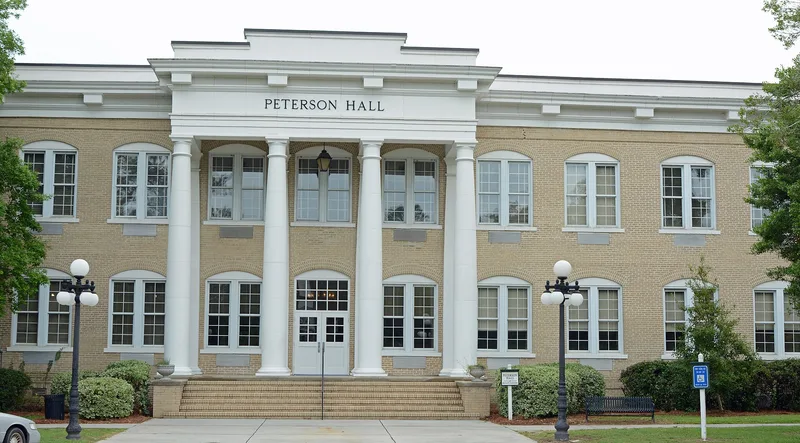
Southwest of downtown Douglas, Georgia, this campus core began in 1907 as the Eleventh District Agricultural and Mechanical School. Atlanta architect Haralson Bleckley designed its three original buildings, Peterson Hall and the flanking Davis and Powell halls, arranged around a semicircular drive and large lawn typical of Georgia's district A & M schools. Later additions include a 1927 dining hall, a relocated log tobacco barn that recalls the school's farm instruction, a 1936 gymnasium and 1939 library built with Public Works Administration help, and postwar housing and academic buildings. The district counts 13 contributing buildings and one contributing structure, the network of roads and walkways. Its importance rests on the school's history. When the district school system faced closure in the 1920s, principal Joseph M. Thrash won legislation in 1927 that turned the school into Georgia's first state-supported junior college. The campus is still used for higher education, and its exteriors remain largely intact despite interior renovations.
Machine-generated summary. This summary was generated by a language model from the official nomination document and has not been reviewed line by line by an editor. It may contain errors. Check the source document before relying on any detail. Source: nomination document (PDF) · catalog entry. Generated October 2026 (model claude-sonnet-5-5, prompt v1.0-2026-10-29).
| Styles | Colonial Revival, Classical Revival, International Style, Ranch |
|---|---|
| Areas of significance | Architecture, Education |
| Acreage | 48 |
| Boundary source | NPS cultural-resource GIS polygon |
| Full listing page | Eleventh District A & M School-South Georgia College Historic District (property record) |
What listing means for this property
This is a historic district. Buildings within its boundary are either contributing (they add to the district's significance) or non-contributing. Owners of contributing income-producing buildings can claim the 20% federal rehabilitation tax credit; homeowners should look at state credits. National Register districts impose no design review by themselves; a local historic district ordinance, if one exists, does (the difference explained).
General information, not legal or tax advice. Rules change; confirm with your State Historic Preservation Office or a qualified adviser.