Briarcliff

The National Park Service has not published a boundary polygon for this district; the map shows the listed properties inside it and the district's reference point.
Why it's listed
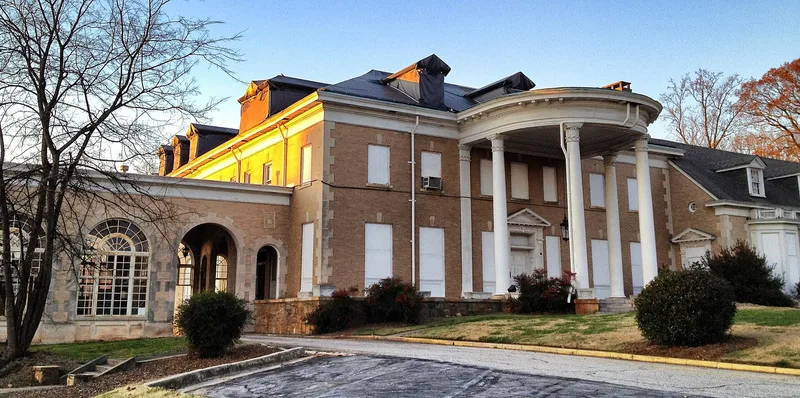
Briarcliff is a large Georgian Revival mansion on ten acres at 1260 Briarcliff Road in Atlanta, once part of a forty-two-acre estate built for Asa G. Candler, Jr. The three-story buff brick house, finished in 1922, has a semicircular portico with four Corinthian columns and sits on a rusticated granite base. Architect Charles E. Frazier designed it. Inside, the standout is the Music Room, now DeOvies Hall, a three-story space with carved oak panels, a stone fireplace and faux-wood trusses. Surviving grounds features include a seven-foot granite wall, terraces, pergolas, greenhouses, a carriage house and a bathhouse. Candler, a son of the Coca-Cola president, ran a private zoo from 1932 to 1935, operated a public pool from 1933, and was active in real estate and cemetery development. The property was recognized for his role in Atlanta's social history and for the quality of its architecture. It has served for decades as a counseling and rehabilitation center.
Machine-generated summary. This summary was generated by a language model from the official nomination document and has not been reviewed line by line by an editor. It may contain errors. Check the source document before relying on any detail. Source: nomination document (PDF) · catalog entry. Generated October 2026 (model claude-sonnet-5-5, prompt v1.0-2026-10-29).
| Styles | Late 19th and 20th Century Revivals: Colonial Revival/Georgian Revival |
|---|---|
| Areas of significance | Entertainment/Recreation, Architecture, Social History |
| Acreage | 0.9 |
| Boundary source | not published |
| Full listing page | Briarcliff (property record) |
What listing means for this property
This is a historic district. Buildings within its boundary are either contributing (they add to the district's significance) or non-contributing. Owners of contributing income-producing buildings can claim the 20% federal rehabilitation tax credit; homeowners should look at state credits. National Register districts impose no design review by themselves; a local historic district ordinance, if one exists, does (the difference explained).
General information, not legal or tax advice. Rules change; confirm with your State Historic Preservation Office or a qualified adviser.