Birdsville Plantation

The National Park Service has not published a boundary polygon for this district; the map shows the listed properties inside it and the district's reference point.
Why it's listed
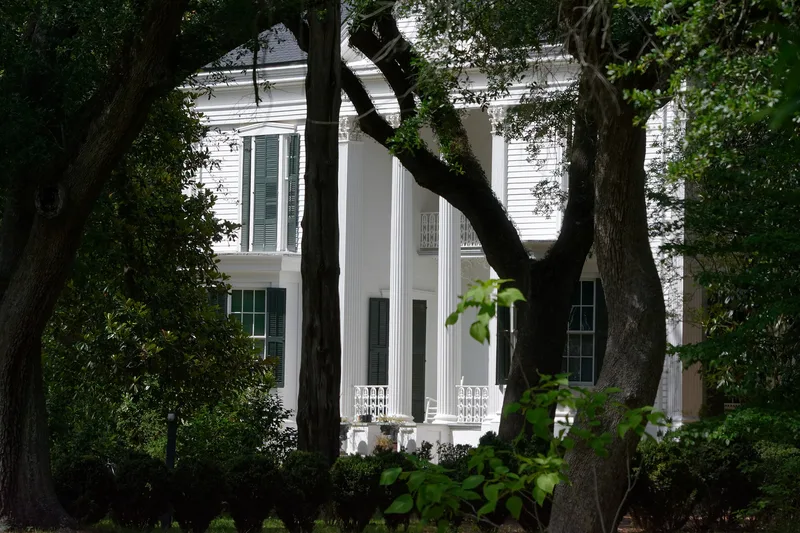
Birdsville Plantation is a crossroads farm complex northwest of Millen, Georgia, built around a main house that grew in two stages. Philip Jones, who received a 287-acre land grant in 1784 for Revolutionary War service, built the rear section before his death in 1789. About 1850, Dr. William B. Jones added a Greek Revival front with twin Corinthian columns, a heavy cornice and pediment, twin bays, ironwork and Carpenter Gothic scrollwork, all financed by cotton. Inside, the early rooms have Federal woodwork, and a stair hall door is grained so convincingly that it looks like panelled wood. Around the house stand a two-room kitchen, well house, smokehouse, blacksmith shop, stagestop-apothecary, cotton gin, barn, family burial ground and an avenue of old trees. The land has passed through the same family since the grant. The nomination calls it perhaps the only complete and essentially unaltered plantation complex surviving in Georgia. The listed area was later set at 50 acres.
Machine-generated summary. This summary was generated by a language model from the official nomination document and has not been reviewed line by line by an editor. It may contain errors. Check the source document before relying on any detail. Source: nomination document (PDF) · catalog entry. Generated October 2026 (model claude-sonnet-5-5, prompt v1.0-2026-10-29).
| Period of significance | 18th and 19th centuries (specific dates c. 1789 and c. 1850) |
|---|---|
| Styles | Federal woodwork in the early rear section; Greek Revival front section with Carpenter Gothic scrollwork on the side porch |
| Areas of significance | Architecture |
| Acreage | 50 |
| Boundary source | not published |
| Full listing page | Birdsville Plantation (property record) |
What listing means for this property
This is a historic district. Buildings within its boundary are either contributing (they add to the district's significance) or non-contributing. Owners of contributing income-producing buildings can claim the 20% federal rehabilitation tax credit; homeowners should look at state credits. National Register districts impose no design review by themselves; a local historic district ordinance, if one exists, does (the difference explained).
General information, not legal or tax advice. Rules change; confirm with your State Historic Preservation Office or a qualified adviser.