Avondale Estates Historic District

Why it's listed
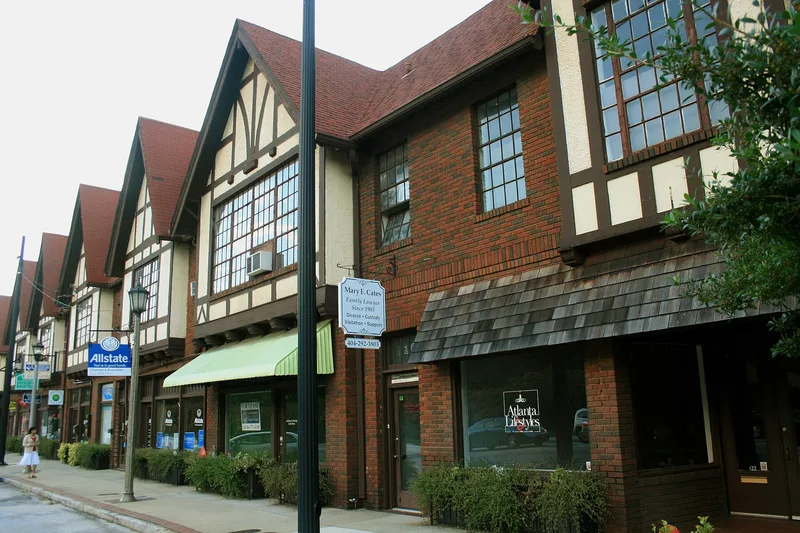
Avondale Estates Historic District covers the historic core of a planned suburban town begun in 1924 along Covington Highway, east of Atlanta. Developer George F. Willis laid out the town around an English Village theme, and the district includes its commercial center, residential streets, two parks, three small interior-block parks, landscaped medians and traffic circles, a former trolley corridor and a ceremonial entrance gate. The commercial blocks of 1925 are Tudor Revival buildings with half-timbering, gables and tile roofs. Houses built between 1924 and 1941 are mostly small cottages, many with English-inspired details, along with larger Tudor Revival and Dutch Colonial Revival homes. Robert Cridland served as landscape architect, and the Flagler Construction Company built many of the houses. The district was recognized as the only documented early 20th century planned new town in Georgia and the Southeast, and for its intact planning, landscape and architecture from 1924 to 1941. About 178 resources contribute and 160 newer houses do not.
Machine-generated summary. This summary was generated by a language model from the official nomination document and has not been reviewed line by line by an editor. It may contain errors. Check the source document before relying on any detail. Source: nomination document (PDF) · catalog entry. Generated October 2026 (model claude-sonnet-5-5, prompt v1.0-2026-10-29).
| Period of significance | 1924-1941 |
|---|---|
| Styles | Tudor Revival, English Cottage, Dutch Colonial Revival, with some Craftsman/Bungalow and Spanish Mission examples |
| Areas of significance | Community Planning and Development, Landscape Architecture, Commerce, Architecture |
| Acreage | 125 |
| Boundary source | NPS cultural-resource GIS polygon |
| Full listing page | Avondale Estates Historic District (property record) |
What listing means for this property
This is a historic district. Buildings within its boundary are either contributing (they add to the district's significance) or non-contributing. Owners of contributing income-producing buildings can claim the 20% federal rehabilitation tax credit; homeowners should look at state credits. National Register districts impose no design review by themselves; a local historic district ordinance, if one exists, does (the difference explained).
General information, not legal or tax advice. Rules change; confirm with your State Historic Preservation Office or a qualified adviser.