Washington Court

The National Park Service has not published a boundary polygon for this district; the map shows the listed properties inside it and the district's reference point.
Why it's listed
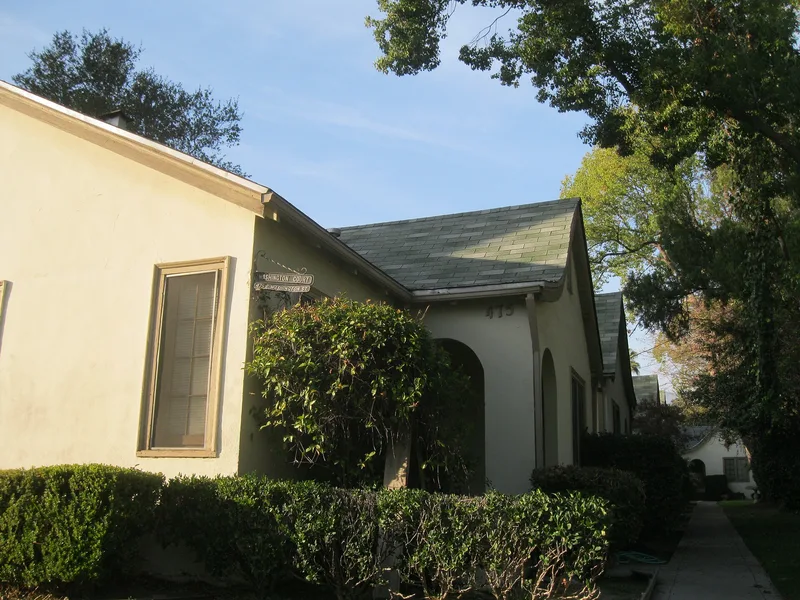
Six small cottages and a garage form a bungalow court at 475 East Washington Boulevard in Pasadena. Built in 1924 for F. R. Finch at a cost of $2,250 per residence, the court is arranged in an L shape on a long, narrow lot. Each wood-frame unit sits on a concrete foundation and has stucco walls, a cross-gabled roof, flared eaves over an arched entry, wood casement and double-hung windows, and wide wood trim. The cottages face a shared landscaped garden on the east side, while a driveway on the west gives access to each kitchen entrance and to the rear garage. A river rock retaining wall surrounds the site. The court was recognized for architecture as one of the best Pasadena examples of the half-court form, which balanced shared amenities with privacy. It also illustrates the English Cottage Revival style common in 1920s housing. Few changes have been made, and the architect and builder are unknown. It remains in residential use.
Machine-generated summary. This summary was generated by a language model from the official nomination document and has not been reviewed line by line by an editor. It may contain errors. Check the source document before relying on any detail. Source: nomination document (PDF) · catalog entry. Generated October 2026 (model claude-sonnet-5-5, prompt v1.0-2026-10-29).
| Period of significance | 1924 |
|---|---|
| Styles | English Cottage Revival |
| Areas of significance | Architecture |
| Acreage | 0.9 |
| Boundary source | not published |
| Full listing page | Washington Court (property record) |
What listing means for this property
This is a historic district. Buildings within its boundary are either contributing (they add to the district's significance) or non-contributing. Owners of contributing income-producing buildings can claim the 20% federal rehabilitation tax credit; homeowners should look at state credits. National Register districts impose no design review by themselves; a local historic district ordinance, if one exists, does (the difference explained).
General information, not legal or tax advice. Rules change; confirm with your State Historic Preservation Office or a qualified adviser.