Venetian Court Apartments

The National Park Service has not published a boundary polygon for this district; the map shows the listed properties inside it and the district's reference point.
Why it's listed
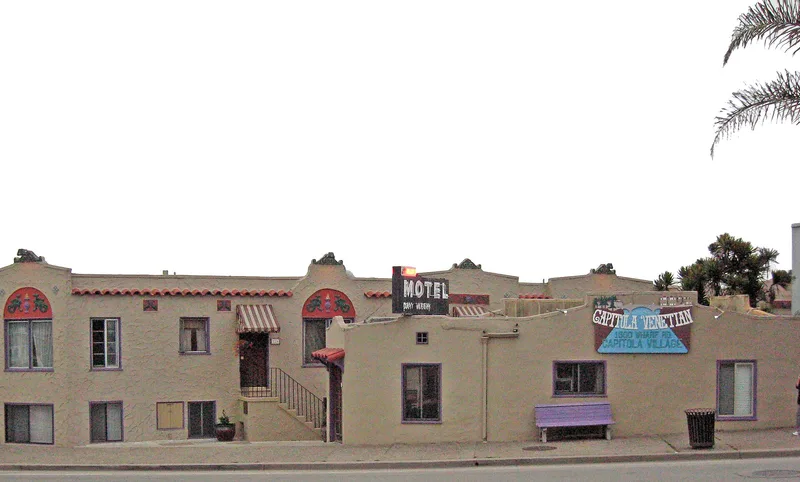
Venetian Court is a beachfront complex of five stucco buildings at the foot of the Capitola Wharf, built in 1925 on a curving, one-acre site. It contains 24 townhouses, a 17-unit motel and a small triangular office. Designed by San Jose architects Wolfe and Higgins for developer Henry J. Roth, the wood-frame buildings show Spanish Colonial Revival and Mediterranean influence, with flat roofs, pointed parapets, small pyramidal-capped towers, tile details and plaster relief work including gargoyles and dolphins. The land came from a subdivision filed by resort owner H. Allen Rispin, who wanted to give Capitola a Venetian flavor; the site had earlier held fishermen's shanties. Individually owned units sold from 1925, making it possibly one of the first condominium-style developments in California. Storms, window replacements and interior changes have altered parts of the complex, yet it keeps much of its original appearance and remains a local landmark.
Machine-generated summary. This summary was generated by a language model from the official nomination document and has not been reviewed line by line by an editor. It may contain errors. Check the source document before relying on any detail. Source: nomination document (PDF) · catalog entry. Generated October 2026 (model claude-sonnet-5-5, prompt v1.0-2026-10-29).
| Period of significance | 1925 |
|---|---|
| Styles | Spanish Colonial Revival-Mediterranean |
| Areas of significance | Commerce, Architecture |
| Acreage | 1 |
| Boundary source | not published |
| Full listing page | Venetian Court Apartments (property record) |
What listing means for this property
This is a historic district. Buildings within its boundary are either contributing (they add to the district's significance) or non-contributing. Owners of contributing income-producing buildings can claim the 20% federal rehabilitation tax credit; homeowners should look at state credits. National Register districts impose no design review by themselves; a local historic district ordinance, if one exists, does (the difference explained).
General information, not legal or tax advice. Rules change; confirm with your State Historic Preservation Office or a qualified adviser.