South Serrano Avenue Historic District

The National Park Service has not published a boundary polygon for this district; the map shows the listed properties inside it and the district's reference point.
Why it's listed
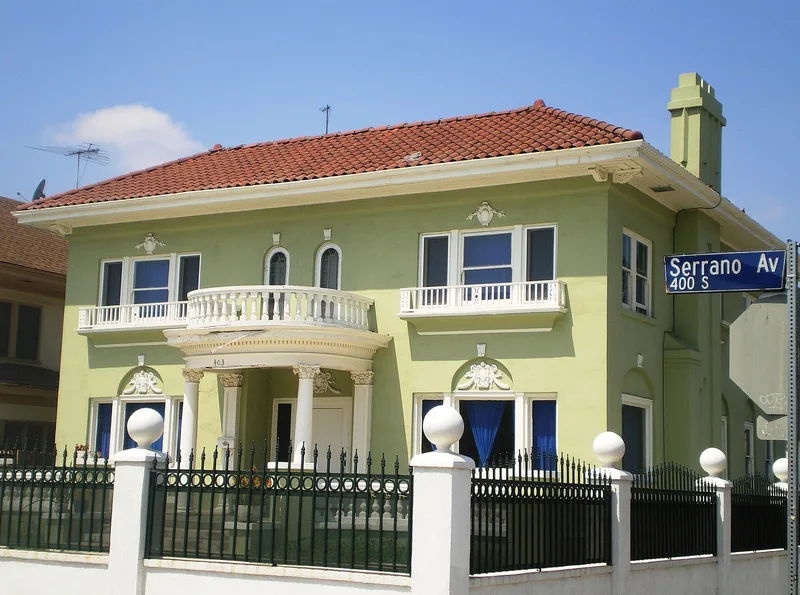
This residential district covers the 400 block of South Serrano Avenue in Los Angeles, between 4th and 5th Streets, three blocks north of Wilshire Boulevard. It holds eighteen houses and two vacant lots. Most of the houses date from about 1913 to 1920, and only one altered house and the two empty lots are counted as non-contributing. The block was built up with large two-story homes on generous lots, many with original garages, some with servants' quarters above, and the original scored concrete sidewalks survive. Styles include Neoclassical, Colonial Revival, Tudor Revival and Prairie School, including a relatively rare Prairie example at 421 South Serrano. Architects and builders named include Henry J. Knauer, Henry H. Whiteley, Frank M. Tyler, and the Cooper-Pyle-Clopine Company. Early residents included attorneys, bankers, real estate figures and business owners. The nomination stresses that no other block in the surrounding area has such a consistent, intact grouping with so few intrusions, and most houses remain in good to excellent condition.
Machine-generated summary. This summary was generated by a language model from the official nomination document and has not been reviewed line by line by an editor. It may contain errors. Check the source document before relying on any detail. Source: nomination document (PDF) · catalog entry. Generated October 2026 (model claude-sonnet-5-5, prompt v1.0-2026-10-29).
| Styles | Neoclassical, Prairie/Craftsman, Colonial Revival, Tudor Revival |
|---|---|
| Areas of significance | Exploration/Settlement, Architecture |
| Acreage | 5.2 |
| Boundary source | not published |
| Full listing page | South Serrano Avenue Historic District (property record) |
What listing means for this property
This is a historic district. Buildings within its boundary are either contributing (they add to the district's significance) or non-contributing. Owners of contributing income-producing buildings can claim the 20% federal rehabilitation tax credit; homeowners should look at state credits. National Register districts impose no design review by themselves; a local historic district ordinance, if one exists, does (the difference explained).
General information, not legal or tax advice. Rules change; confirm with your State Historic Preservation Office or a qualified adviser.