Santa Barbara Presidio

The National Park Service has not published a boundary polygon for this district; the map shows the listed properties inside it and the district's reference point.
Why it's listed
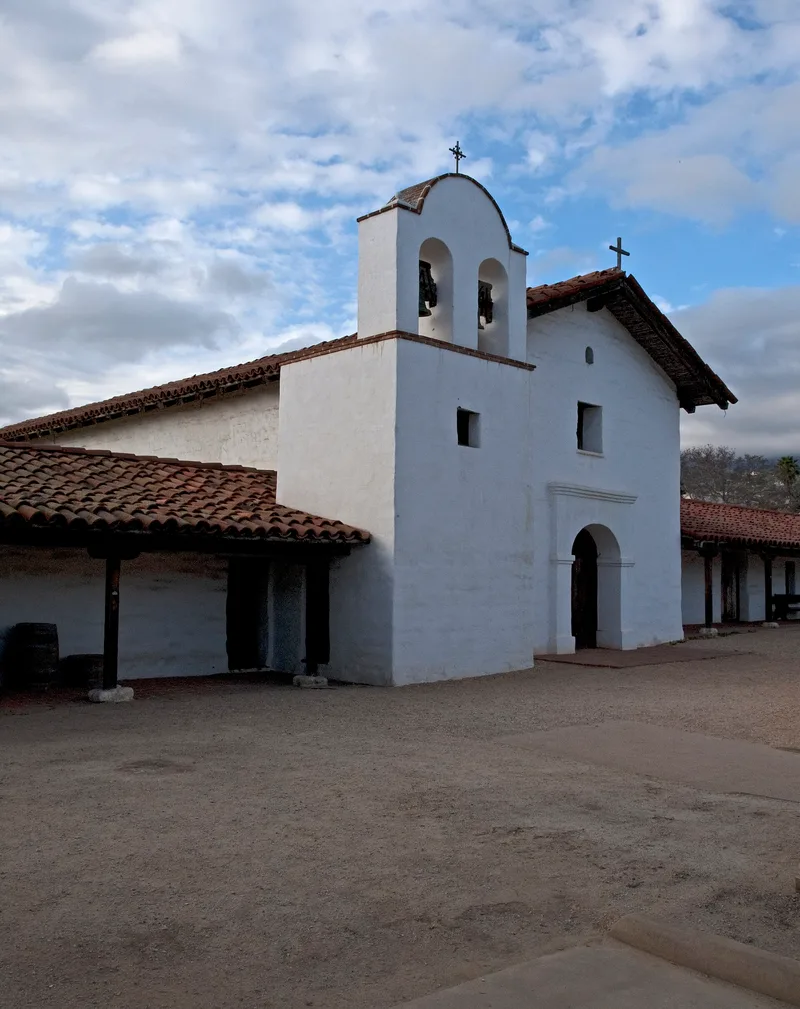
Four blocks of downtown Santa Barbara mark the site of the Royal Presidio, a Spanish fort founded in 1782 as the fourth and last presidio of Alta California. Captain Felipe de Goycoechea began a permanent adobe quadrangle in 1788, with barracks, family quarters, officers' houses and a chapel around a central plaza, enclosed by defense walls and bastions. Most of it was complete by 1790, and the chapel was enlarged in 1797 after a fire. The presidio guarded a military district of about 7,000 square miles and remained in use until 1850. Two original buildings survive in restored form: El Cuartel, a soldiers' family quarter, and the Caneda Adobe, a former officer's quarters. Excavations have uncovered chapel foundations and both defense walls. The detailed original plans allow accurate reconstruction, and the area remains the historical center of the city. It is listed as a district.
Machine-generated summary. This summary was generated by a language model from the official nomination document and has not been reviewed line by line by an editor. It may contain errors. Check the source document before relying on any detail. Source: nomination document (PDF) · catalog entry. Generated October 2026 (model claude-sonnet-5-5, prompt v1.0-2026-10-29).
| Period of significance | 18th and 19th centuries; specific dates 1788 and 1850 |
|---|---|
| Areas of significance | Community Planning and Development, Historic - Aboriginal, Military, Architecture |
| Acreage | 5.4 |
| Boundary source | not published |
| Full listing page | Santa Barbara Presidio (property record) |
What listing means for this property
This is a historic district. Buildings within its boundary are either contributing (they add to the district's significance) or non-contributing. Owners of contributing income-producing buildings can claim the 20% federal rehabilitation tax credit; homeowners should look at state credits. National Register districts impose no design review by themselves; a local historic district ordinance, if one exists, does (the difference explained).
General information, not legal or tax advice. Rules change; confirm with your State Historic Preservation Office or a qualified adviser.