San Francisco State Teacher's College

The National Park Service has not published a boundary polygon for this district; the map shows the listed properties inside it and the district's reference point.
Why it's listed
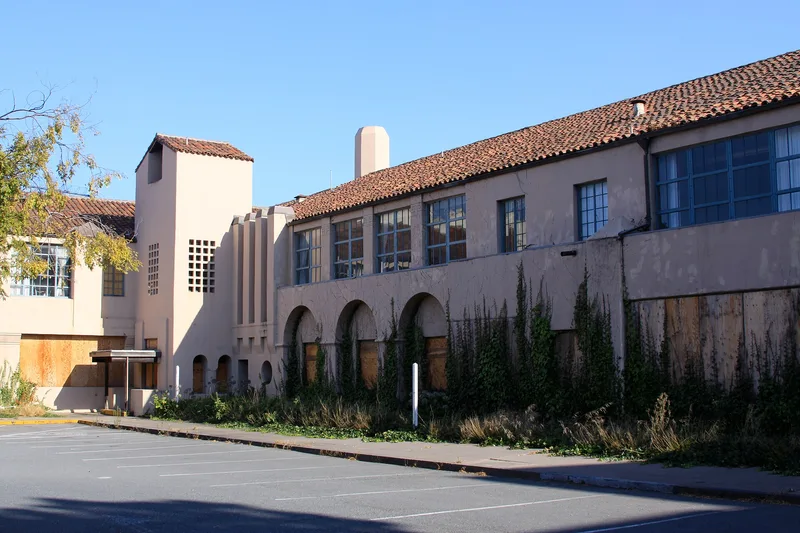
This campus occupies two blocks of a steep terraced hill in San Francisco's Hayes Valley. It was built from 1924 to 1935 for the San Francisco State Teachers' College from designs by the California State Architect. Four contributing buildings, Richardson Hall, Woods Hall, Woods Hall Annex and Middle Hall, are reinforced concrete with stucco walls, red Mission tile roofs and industrial windows, all in Spanish Colonial Revival style, with some Moderne touches in Richardson Hall. The buildings face inward toward a central open area, while plain exterior walls and a high retaining wall along Laguna Street give the complex a self-enclosed, cloister-like character. Bernard Maybeck produced an early scheme, but State Architect George B. McDougall simplified it into the built design. The campus trained teachers from 1924 until 1957, when it was transferred to the University of California as an extension center. Two WPA murals survive, and the buildings retain a high degree of integrity. A 1970s dental school building does not contribute.
Machine-generated summary. This summary was generated by a language model from the official nomination document and has not been reviewed line by line by an editor. It may contain errors. Check the source document before relying on any detail. Source: nomination document (PDF) · catalog entry. Generated October 2026 (model claude-sonnet-5-5, prompt v1.0-2026-10-29).
| Period of significance | 1924-1957 |
|---|---|
| Styles | Spanish Colonial Revival |
| Areas of significance | Education |
| Acreage | 5.9 |
| Boundary source | not published |
| Full listing page | San Francisco State Teacher's College (property record) |
What listing means for this property
This is a historic district. Buildings within its boundary are either contributing (they add to the district's significance) or non-contributing. Owners of contributing income-producing buildings can claim the 20% federal rehabilitation tax credit; homeowners should look at state credits. National Register districts impose no design review by themselves; a local historic district ordinance, if one exists, does (the difference explained).
Noted as vacant in the nomination. Nomination documents can be decades old; current status may differ. If you are considering buying an empty listed property, read the due-diligence checklist.
General information, not legal or tax advice. Rules change; confirm with your State Historic Preservation Office or a qualified adviser.