San Diego State College

Why it's listed
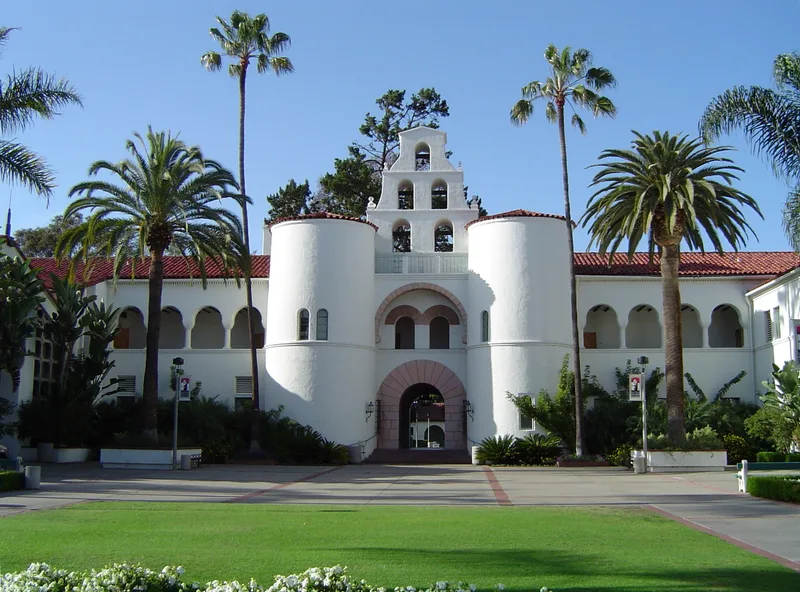
The historic core of San Diego State University is a campus district planned in the late 1920s and built from 1930, when the college moved to a new mesa-top site overlooking Alvarado Canyon. Architect Howard Spencer Hazen designed the original buildings in Spanish Colonial Revival style with Moorish and Mission Revival details, grouping them around quadrangles like a Spanish monastery. The Academic Building's southern entry, with round towers, a rusticated arch and a bell tower, is the best-known feature. Land was donated by Alphonzo Bell's company, and Mark Daniels contributed landscape planning. Works Progress Administration labor added buildings, an arcade, benches and Donal Hord's Aztec statue during the 1930s and early 1940s. The district was recognized for its link to President Edward Hardy's holistic vision of education, continued by Walter Hepner, for its architecture, and for its WPA work. Despite later alterations and the loss of most of Aztec Bowl, the core retains its original character and remains in use.
Machine-generated summary. This summary was generated by a language model from the official nomination document and has not been reviewed line by line by an editor. It may contain errors. Check the source document before relying on any detail. Source: nomination document (PDF) · catalog entry. Generated October 2026 (model claude-sonnet-5-5, prompt v1.0-2026-10-29).
| Period of significance | 1930-1947 |
|---|---|
| Styles | Late nineteenth- and twentieth-century revivals / Spanish Colonial Revival (with strong Mission Revival and Moorish elements) |
| Areas of significance | Architecture, Social History, Education |
| Acreage | 10 |
| Boundary source | NPS cultural-resource GIS polygon |
| Full listing page | San Diego State College (property record) |
What listing means for this property
This is a historic district. Buildings within its boundary are either contributing (they add to the district's significance) or non-contributing. Owners of contributing income-producing buildings can claim the 20% federal rehabilitation tax credit; homeowners should look at state credits. National Register districts impose no design review by themselves; a local historic district ordinance, if one exists, does (the difference explained).
General information, not legal or tax advice. Rules change; confirm with your State Historic Preservation Office or a qualified adviser.