San Diego Civic Center

Why it's listed
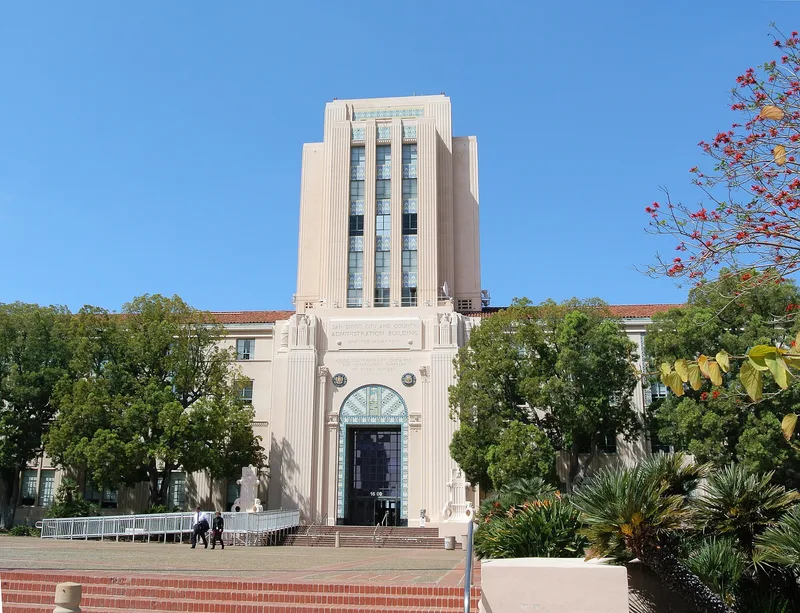
Built between 1936 and 1938 on reclaimed bayfront tidelands, the San Diego Civic Center originally housed both city and county offices and now serves as the County Administration Center. The reinforced concrete building combines Spanish Revival and Streamline Moderne styling with Beaux-Arts touches, a Mission tile roof, inlaid Franciscan pottery tile, and a ten-story central tower. Inside are marble-covered lobbies, bronze detailing and Philippine mahogany stairs. Over 1,500 steel pilings and a five-section structure were used to resist earthquakes. Four San Diego architects designed it: Louis J. Gill, Samuel W. Hamill, William T. Johnson and Richard S. Requa. Funding came largely from the Works Progress Administration. The site includes Donal Hord's granite Guardian of Water sculpture and fountain, placed in 1939, and Roland Hoyt's landscaping. The location reflects John Nolen's 1926 city plan, which envisioned a paseo linking civic buildings to Balboa Park, though that was never realized. Stories were added to the wings in 1968.
Machine-generated summary. This summary was generated by a language model from the official nomination document and has not been reviewed line by line by an editor. It may contain errors. Check the source document before relying on any detail. Source: nomination document (PDF) · catalog entry. Generated October 2026 (model claude-sonnet-5-5, prompt v1.0-2026-10-29).
| Period of significance | 1936-1939 |
|---|---|
| Styles | Moderne; Spanish Revival (Spanish Revival with Streamline Moderne influences and Beaux-Arts touches) |
| Areas of significance | Community Planning and Development, Landscape Architecture, Art, Engineering, Politics/Government, Architecture |
| Acreage | 16.7 |
| Boundary source | NPS cultural-resource GIS polygon |
| Full listing page | San Diego Civic Center (property record) |
What listing means for this property
This is a historic district. Buildings within its boundary are either contributing (they add to the district's significance) or non-contributing. Owners of contributing income-producing buildings can claim the 20% federal rehabilitation tax credit; homeowners should look at state credits. National Register districts impose no design review by themselves; a local historic district ordinance, if one exists, does (the difference explained).
General information, not legal or tax advice. Rules change; confirm with your State Historic Preservation Office or a qualified adviser.