Palace of Fine Arts

Why it's listed
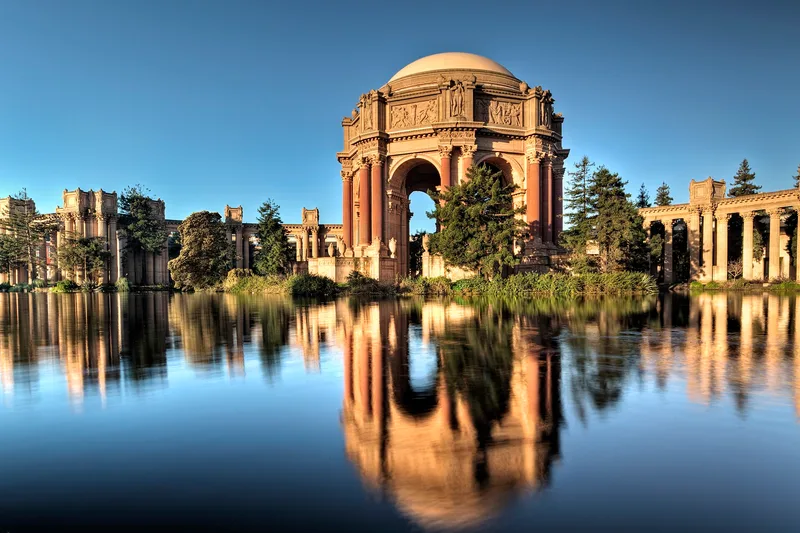
Set beside a lagoon at the west end of San Francisco's Marina District, this 16.99-acre park contains a domed rotunda, two curving colonnades and a long exhibition building. The complex was rebuilt between 1964 and 1974 from Bernard Maybeck's design for the 1915 Panama-Pacific International Exposition, after the original plaster-and-wood structures deteriorated and were demolished in 1963-64. The rotunda and colonnades are poured and cast concrete, while the exhibition building keeps its 1915 steel frame under stucco textured to suggest travertine. Details were cast from the originals, though much of the exhibition building's ornament was omitted for cost reasons. The reconstruction was funded before any use was decided, largely through gifts from Walter Johnson, and the building later housed a science museum and a theater. The nomination treats the rebuilt Palace as an example of Beaux-Arts classicism with a high degree of integrity for 1964-1967 and 1973-1974, and as a widely recognized San Francisco landmark.
Machine-generated summary. This summary was generated by a language model from the official nomination document and has not been reviewed line by line by an editor. It may contain errors. Check the source document before relying on any detail. Source: nomination document (PDF) · catalog entry. Generated October 2026 (model claude-sonnet-5-5, prompt v1.0-2026-10-29).
| Period of significance | 1964-1967 and 1973-1974 |
|---|---|
| Styles | Beaux Arts |
| Areas of significance | Conservation |
| Acreage | 17 |
| Boundary source | NPS cultural-resource GIS polygon |
| Full listing page | Palace of Fine Arts (property record) |
What listing means for this property
This is a historic district. Buildings within its boundary are either contributing (they add to the district's significance) or non-contributing. Owners of contributing income-producing buildings can claim the 20% federal rehabilitation tax credit; homeowners should look at state credits. National Register districts impose no design review by themselves; a local historic district ordinance, if one exists, does (the difference explained).
General information, not legal or tax advice. Rules change; confirm with your State Historic Preservation Office or a qualified adviser.