Market Street Theatre and Loft District
Why it's listed
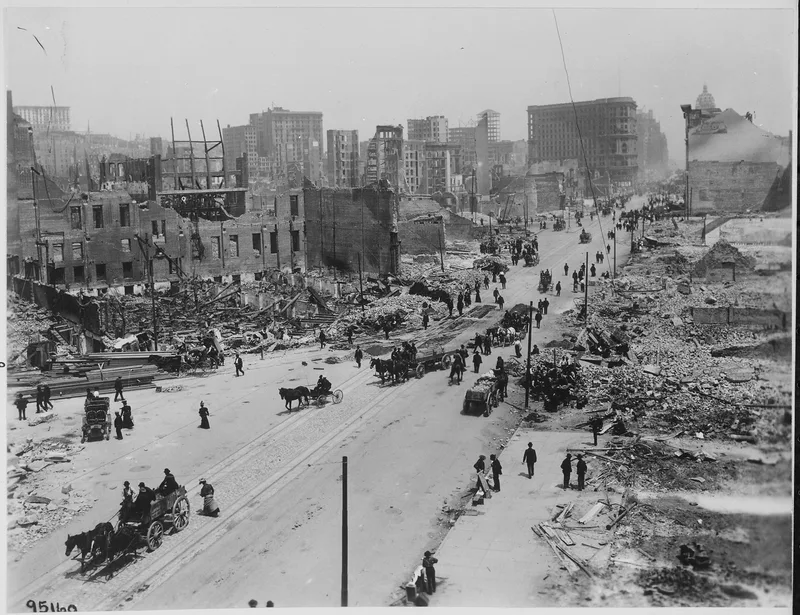
Along roughly 1,200 feet of Market Street near Sixth and Seventh Streets in San Francisco, thirty commercial buildings form a district of theatres, loft stores, offices, hotels, a bank and a lodge. Most date from 1900 to 1926, rebuilt in a consistent Commercial Style after the 1906 earthquake and fire, with terra cotta, brick and steel frames. Twenty buildings contribute to the district; ten are modern intrusions. Two intersections stand out, one centered on the 1922 Golden Gate Theatre by G. Albert Lansburgh and the other on Albert Pissis' 1892 Hibernia Bank. The area served as a secondary downtown, with large furniture and department stores, and as the place where major studios opened first-run films in studio-owned picture palaces. Market Street's 120-foot width also made it a favored parade route. Labor organizer Tom Mooney was photographed atop the Wilson Building during the 1916 Preparedness Day Parade. Ground-floor shops have been altered often, but upper stories largely survive.
Machine-generated summary. This summary was generated by a language model from the official nomination document and has not been reviewed line by line by an editor. It may contain errors. Check the source document before relying on any detail. Source: nomination document (PDF) · catalog entry. Generated October 2026 (model claude-sonnet-5-5, prompt v1.0-2026-10-29).
| Period of significance | 1889-1930 |
|---|---|
| Styles | The Commercial Style, with Renaissance-Baroque and other historicist ornamentation |
| Areas of significance | Commerce, Entertainment/Recreation, Architecture |
| Acreage | 13.1 |
| Boundary source | NPS cultural-resource GIS polygon |
| Full listing page | Market Street Theatre and Loft District (property record) |
What listing means for this property
This is a historic district. Buildings within its boundary are either contributing (they add to the district's significance) or non-contributing. Owners of contributing income-producing buildings can claim the 20% federal rehabilitation tax credit; homeowners should look at state credits. National Register districts impose no design review by themselves; a local historic district ordinance, if one exists, does (the difference explained).
General information, not legal or tax advice. Rules change; confirm with your State Historic Preservation Office or a qualified adviser.